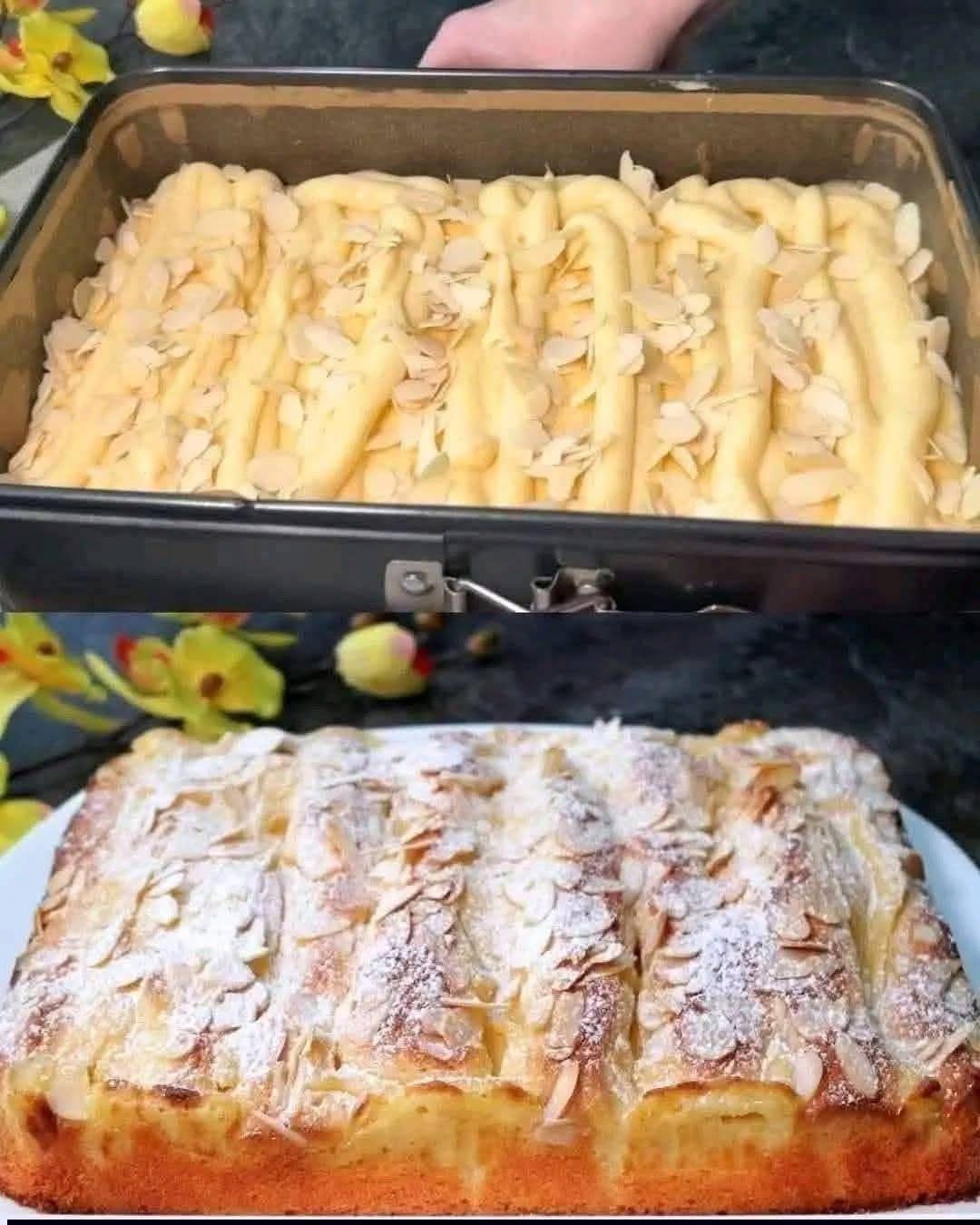
This Creamy Almond Custard Sheet Cake combines a soft vanilla cake with thick ribbons of silky custard, toasted sliced almonds, and a delicate dusting of powdered sugar.
The cake batter rises around the piped custard while baking, creating a beautiful ridged surface and creamy pockets inside every slice. The almonds become lightly toasted in the oven, adding a gentle crunch that contrasts with the tender cake and smooth filling.
This homemade dessert looks elegant enough for birthdays, holidays, brunches, family celebrations, potlucks, and afternoon coffee. However, it is prepared with familiar ingredients and does not require complicated decorating techniques.
The cake tastes delicious at room temperature, but chilling it makes the custard firmer and allows the slices to hold their shape more cleanly.
Why This Recipe Is Popular
Almond custard cake is popular because it combines several comforting textures in one simple pan.
The vanilla cake is soft and lightly sweet. The custard remains creamy, while the sliced almonds create a toasted and slightly crisp topping.
The piped custard also gives the cake a decorative bakery-style appearance before any frosting is added.
This recipe is convenient for gatherings because it is baked in one rectangular pan and can be cut into many portions. It can also be prepared one day ahead and stored in the refrigerator until serving time.
The finished cake requires only powdered sugar for decoration, making it easier than a traditional layered or frosted cake.
Recipe Information
The preparation time is approximately thirty minutes.
The custard requires approximately ten minutes of cooking and twenty minutes of cooling.
The baking time is approximately thirty-five to forty-five minutes.
Allow at least one hour for cooling before cutting.
The recipe provides approximately twelve to sixteen portions.
Main Ingredients
All-purpose flour gives the cake enough structure to hold the custard while keeping the crumb tender.
Butter adds richness and a soft texture.
Eggs help the batter rise and create stability.
Whole milk keeps both the cake and custard moist.
Cornstarch thickens the custard so it remains in visible ribbons rather than disappearing into the batter.
Vanilla extract creates the warm base flavor, while almond extract adds a delicate bakery-style aroma.
Sliced almonds provide texture and become lightly golden while the cake bakes.
Ingredients for the Vanilla Custard
For the custard, you will need two cups of whole milk, four large egg yolks, half a cup of granulated sugar, one-quarter cup of cornstarch, two teaspoons of vanilla extract, half a teaspoon of almond extract, two tablespoons of unsalted butter, and a small pinch of salt.
The almond extract is optional, but a small amount gives the filling a deeper almond flavor.
Avoid adding too much almond extract because it is strong and can overpower the vanilla.
Ingredients for the Cake Batter
For the cake batter, you will need two and a half cups of all-purpose flour, two teaspoons of baking powder, half a teaspoon of baking soda, and half a teaspoon of salt.
You will also need three-quarters of a cup of softened unsalted butter, one and one-quarter cups of granulated sugar, four large eggs at room temperature, two teaspoons of vanilla extract, one cup of whole milk, and one-quarter cup of sour cream or plain Greek yogurt.
For the topping, you will need approximately three-quarters of a cup of sliced almonds and two or three tablespoons of powdered sugar.
The Best Baking Pan to Use
A nine-by-thirteen-inch metal baking pan works well for this recipe.
A rectangular springform pan can also be used when you want to remove the entire cake before slicing.
Line the bottom and sides with parchment paper.
Leave enough parchment hanging over two opposite sides to create handles.
The parchment helps prevent the custard and cake from sticking and makes removal easier after cooling.
Lightly grease the pan before adding the parchment so the paper stays in place.
Why Room-Temperature Ingredients Matter
Room-temperature butter, eggs, milk, and sour cream combine more smoothly.
Cold ingredients can cause the batter to separate and may produce a heavier texture.
Remove the refrigerated ingredients approximately thirty to sixty minutes before beginning.
They should not become hot. They only need to lose their refrigerator chill.
Room-temperature ingredients help the cake rise evenly and create a softer crumb.
How to Prepare the Vanilla Custard
Pour the milk into a medium saucepan.
Heat it over medium-low heat until it begins steaming and small bubbles appear around the edges.
Do not allow the milk to boil strongly.
Inside a separate bowl, whisk the egg yolks, sugar, cornstarch, and salt until the mixture becomes smooth and pale.
Slowly pour approximately half a cup of the warm milk into the yolk mixture while whisking continuously.
This gradually warms the eggs and reduces the risk of scrambling.
Continue adding the remaining milk in a slow stream while whisking.
Pour the complete mixture back into the saucepan.
Cook the Custard Until Thick
Place the saucepan over medium-low heat.
Whisk constantly, reaching the bottom and corners of the pan.
After several minutes, the custard will begin to thicken.
Continue cooking until it coats the back of a spoon and falls slowly from the whisk.
Remove the pan from the heat.
Add the butter, vanilla extract, and almond extract.
Stir until the butter melts and the custard becomes smooth and glossy.
When small lumps remain, pass the custard through a fine-mesh strainer.
Cool the Custard Properly
Transfer the cooked custard to a clean bowl.
Press plastic wrap directly against its surface.
This prevents a dry skin from forming.
Allow the custard to cool for approximately twenty to thirty minutes.
It should be thick and warm rather than hot when added to the cake.
Very hot custard may melt the butter inside the batter and affect the cake’s structure.
If the custard becomes too firm, whisk it briefly until smooth before transferring it to a piping bag.
Prepare the Oven and Pan
Preheat the oven to 350°F.
Position the oven rack near the center.
Line and grease the baking pan carefully.
Make sure the parchment reaches the corners so the cake can be lifted easily after cooling.
Place the pan on a stable work surface while preparing the batter.
Combine the Dry Ingredients
Place the flour, baking powder, baking soda, and salt inside a medium bowl.
Whisk until evenly distributed.
Combining the dry ingredients separately helps prevent concentrated areas of baking powder or salt inside the cake.
Set the bowl aside while preparing the butter mixture.
Cream the Butter and Sugar
Place the softened butter and granulated sugar inside a large mixing bowl.
Beat with an electric mixer on medium speed for approximately three to four minutes.
The mixture should become lighter, fluffy, and pale.
Stop the mixer occasionally and scrape the sides and bottom of the bowl.
Properly creaming the butter and sugar incorporates air and helps the cake rise.
Add the Eggs and Vanilla
Add the eggs one at a time.
Mix briefly after every addition.
Allow each egg to become mostly incorporated before adding the next one.
Add the vanilla extract.
Continue mixing only until combined.
Avoid beating excessively after adding the eggs because too much air may cause uneven rising.
Combine the Milk and Sour Cream
Place the milk and sour cream or Greek yogurt inside a measuring cup.
Stir until mostly smooth.
Sour cream provides additional moisture and helps create a tender crumb.
Buttermilk may replace the regular milk for a slightly tangier flavor.
Use plain, unsweetened yogurt when replacing sour cream.
Finish the Cake Batter
Add approximately one-third of the dry ingredients to the butter mixture.
Mix on low speed until partially combined.
Add half of the milk mixture.
Continue alternating the flour and milk, ending with the flour.
Mix only until the dry streaks disappear.
Scrape the bowl and finish folding the batter gently with a silicone spatula.
Overmixing after adding flour can make the cake dense or chewy.
The finished batter should be thick, smooth, and pale yellow.
Spread the Batter in the Pan
Transfer the batter to the prepared baking pan.
Use a spatula to spread it evenly into every corner.
Smooth the surface without pressing too firmly.
Gently tap the pan against the counter once or twice to remove large air pockets.
The batter must remain thick enough to support the custard lines.
Pipe the Custard Over the Batter
Transfer the cooled custard to a piping bag fitted with a large round tip.
A strong resealable bag with one corner cut away can also be used.
Pipe thick parallel lines over the cake batter.
Leave a small amount of space between the lines so the cake can rise around the custard.
You can also create a loose zigzag pattern similar to the dessert shown in the image.
Do not stir the custard into the batter.
It will settle slightly and create creamy ribbons during baking.
Add the Sliced Almonds
Sprinkle the sliced almonds evenly over the surface.
Concentrate some almonds near the custard lines, but cover the entire pan lightly.
Press the almonds very gently so they remain in place.
Do not push them deeply into the batter.
The almonds will toast as the cake bakes and create a lightly crisp surface.
Bake the Almond Custard Cake
Place the pan on the center oven rack.
Bake at 350°F for approximately thirty-five to forty-five minutes.
The cake should rise around the custard ribbons and become golden across the top.
Insert a toothpick into a cake section without custard.
It should come out clean or with a few moist crumbs.
Do not test directly through a custard line because the filling should remain creamy.
If the almonds begin browning too quickly, cover the pan loosely with aluminum foil during the final ten minutes.
How to Know When the Cake Is Ready
The outer edges should feel firm and appear lightly golden.
The cake sections should spring back gently when touched.
The custard may still look slightly soft.
It will become firmer while cooling.
Do not continue baking until the custard becomes dry because the creamy texture is an important part of the recipe.
Cool the Cake
Place the pan on a wire cooling rack.
Allow the cake to cool inside the pan for approximately one hour.
Do not lift or cut it immediately because the warm custard is delicate.
For the cleanest slices, cover the cooled cake and refrigerate it for one or two hours.
Chilling also allows the vanilla and almond flavors to develop.
Add the Powdered Sugar
Once the cake is completely cool, place powdered sugar inside a small sieve.
Dust it lightly over the almonds and golden surface.
Do not add the sugar while the cake is hot because it will dissolve.
Add another light dusting shortly before serving when necessary.
How to Cut Clean Pieces
Lift the cooled cake using the parchment handles.
Place it on a large cutting board.
Use a long, sharp knife.
Wipe the blade between cuts because the custard may stick to it.
For the cleanest presentation, chill the cake before slicing it into squares or rectangles.
Allow the portions to rest at room temperature for approximately ten minutes before serving when you prefer a softer custard.
Want the full recipe and simple step-by-step instructions?
Page 2 continues with the full ingredients, cooking tips, and easy directions so you can make this recipe perfectly at home.