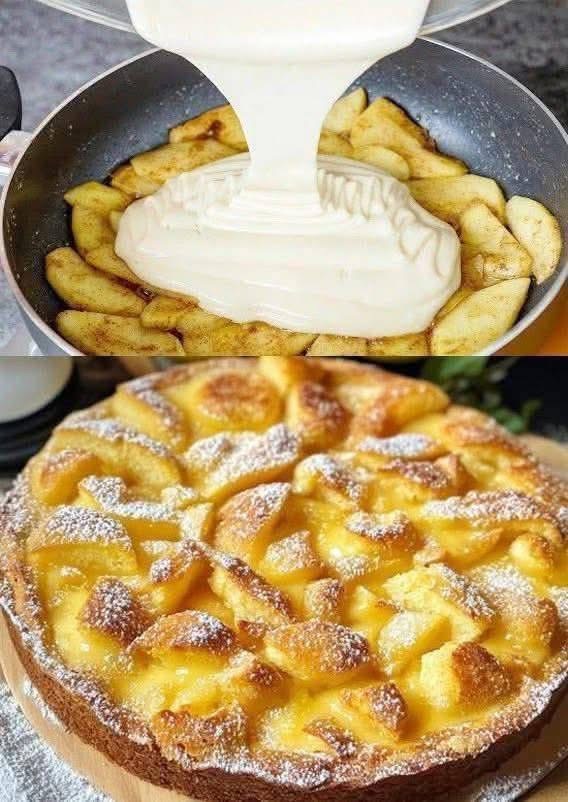
Cinnamon apples cooked in butter, covered with a loose custard batter, and baked in the same skillet until the top puffs golden and the apples rise through it. No crust to make, no pan to line, and it turns out in one piece.
The technique that matters is cooking the apples before the batter goes on. Raw apple slices release a great deal of water in the oven, and inside a thin custard that water thins the batter and leaves a wet layer at the bottom. Eight minutes in butter first drives it off and starts the caramelisation at the same time.
Fifteen minutes at the stove, thirty-five in the oven, and it sets as it cools.
Why You Will Love This Recipe
One skillet from start to finish. Cook the apples, pour the batter over them, and put the whole pan in the oven.
No pastry. The custard forms its own base as it bakes, so there is nothing to roll or blind-bake.
The batter takes two minutes. Eggs, sugar, flour, and milk whisked in a bowl. No mixer and no creaming.
It works with almost any apple. Firmer varieties hold their shape better, but nothing is ruined by using what you have.
It is better on day two. The custard firms overnight and the apple flavour deepens.
Recipe Overview
Prep time: 15 minutes
Cook time: 35 minutes
Cooling time: 1 hour
Total time: 1 hour 50 minutes
Yield: 8 slices
Difficulty: Easy
Best for: Afternoon tea, autumn baking, using up apples, making ahead
Ingredients
For the apples
• 4 medium apples, peeled and sliced ½ inch thick
• 3 tablespoons butter
• 3 tablespoons brown sugar
• 1½ teaspoons cinnamon
• 1 tablespoon lemon juice
• Pinch of salt
For the custard batter
• 4 large eggs
• ¾ cup granulated sugar
• ¾ cup all-purpose flour
• 1 cup whole milk
• ½ cup heavy cream
• 4 tablespoons butter, melted and cooled
• 2 teaspoons vanilla extract
• ½ teaspoon salt
To finish
• 2 tablespoons powdered sugar, for dusting
Choosing the Right Apples
The apple decides whether the slices stay distinct or dissolve into the custard.
Granny Smith. The best choice. Firm, tart, and it holds its shape completely through both the skillet and the oven. The acidity also balances a sweet custard.
Honeycrisp. Crisp and sweet, and it keeps its structure well. A rounder, less sharp result.
Braeburn or Pink Lady. Firm with good acidity. Both excellent here and widely available.
Golden Delicious. Softer and sweeter. It works but the slices break down more, which some people prefer.
Bramley or other cooking apples. They collapse almost entirely into sauce. Fine if you want an apple sauce layer, not if you want slices.
Red Delicious. Mealy and low in acid. Not worth using in a baked dish.
Slice half an inch thick. Thinner slices disappear into the custard and thicker ones stay firm in the middle.
Why the Apples Are Cooked First and Why It Sets by Cooling
Apples are around 85% water. In a hot oven that water comes out steadily, and if the slices go in raw it comes out directly into the batter surrounding them. A custard this loose cannot absorb it, so it thins where the apples sit and the bottom of the cake stays wet even when the top is fully browned.
Eight minutes in a hot skillet solves it before anything else happens. Most of the water evaporates, the sugars in the apple begin to caramelise against the butter, and what remains is fruit that contributes flavour rather than liquid. The brown sugar and cinnamon go in during this stage for the same reason, since they need contact with heat and butter to develop properly.
The setting works like a custard rather than a cake, which is the second thing to understand. Three quarters of a cup of flour against four eggs and a cup and a half of dairy is nowhere near enough flour to build a cake structure. What holds this together is egg protein coagulating, and egg protein sets soft in the oven and firms substantially as it cools.
That makes the usual skewer test misleading. Pull it when the top is deeply golden, the edges have set, and the centre still has a faint wobble. Bake past that and the custard overcooks, weeps liquid, and turns rubbery. Then let it cool for a full hour, because that is when it actually finishes setting.
How to Make Skillet Apple Custard Cake
Step 1: Prepare the skillet
Butter a 10-inch oven-safe skillet generously, including the sides. Preheat the oven to 350°F.
Butter the sides properly. The custard climbs them as it bakes and sticks if they are dry.
Step 2: Slice the apples
Peel, core, and slice the apples half an inch thick, and toss them with the lemon juice.
The lemon slows browning and sharpens the flavour against the sweet custard.
Step 3: Cook the apples
Melt the butter in the skillet over medium heat, add the apples, brown sugar, cinnamon, and salt, and cook 7 to 8 minutes until softened and lightly caramelised.
Stir gently. You want the slices intact, not broken up.
Step 4: Arrange and cool slightly
Spread the apples into an even layer across the pan and take it off the heat for 5 minutes.
Pouring batter into a screaming hot pan starts cooking the eggs immediately.
Step 5: Whisk the eggs and sugar
Whisk the eggs and granulated sugar together for a minute, until pale and slightly thickened.
You are dissolving sugar, not beating in air.
Step 6: Add the flour
Sift the flour and salt over the eggs and whisk until smooth with no lumps.
The mixture will be thick at this stage. That is correct.
Step 7: Add the liquids
Whisk in the milk, cream, cooled melted butter, and vanilla until the batter is thin and smooth.
Let the melted butter cool for a few minutes first, or it will scramble the eggs.
Step 8: Pour and bake
Pour the batter evenly over the apples in the skillet and bake for 33 to 38 minutes, until the top is deeply golden and the centre wobbles only slightly.
Do not wait for a clean skewer. It will be overbaked by then.
Step 9: Cool and dust
Cool in the pan for at least an hour before slicing. Dust with powdered sugar just before serving.
The custard firms as it cools. Cutting warm gives you something spoonable rather than sliceable.
Tips for the Best Apple Custard Cake
Use room-temperature eggs. They combine with the melted butter far more smoothly than cold ones.
Do not overmix the batter. Whisk only until smooth. Overworking develops gluten and toughens the texture.
Use a well-seasoned or nonstick skillet. A bare cast iron pan that has not been buttered thoroughly will hold onto the custard.
Tent with foil if the top browns early. If it is dark at twenty-five minutes, cover it loosely and finish the bake.
Dust the sugar at the last minute. Powdered sugar dissolves into moisture within an hour.
Easy Variations
• Add ½ teaspoon of cardamom or nutmeg to the apples
• Scatter ½ cup of raisins or sultanas over the apples before pouring the batter
• Swap 2 tablespoons of the milk for calvados or dark rum
• Use pears in place of apples, or half and half
• Add ½ cup of chopped toasted walnuts to the apple layer
• Serve with a salted caramel drizzle instead of powdered sugar
What to Serve With It
Warm with a scoop of vanilla ice cream is the classic treatment and hard to improve on. Lightly whipped cream or crème fraîche does the same job with less sweetness.
With coffee in the afternoon it needs nothing at all. A spoonful of thick yoghurt alongside works well if you are serving it at breakfast, which is entirely reasonable.
Make-Ahead and Storage
Make ahead. Better on day two. Bake a day in advance and keep covered at room temperature.
Room temperature. Store covered for up to 2 days.
Fridge. Up to 4 days. Take it out 20 minutes before serving, since cold dulls the flavour.
Freezer. Freeze individual slices, well wrapped, for up to 2 months. Thaw at room temperature.
Reheating. A 325°F oven for 10 minutes brings it back nicely. The microwave works for single slices but softens the top.
Frequently Asked Questions
Can I use a cake pan instead of a skillet?
Yes. Cook the apples in a pan, transfer them to a buttered 9-inch cake tin, and pour the batter over.
Why is my cake wet at the bottom?
The apples were probably not cooked long enough beforehand, or it needs more cooling time. Give it the full hour before judging.
Can I use canned apple slices?
Yes, drained thoroughly. Skip the cooking step and just warm them briefly with the butter and cinnamon.
Is a skewer test reliable here?
No. This sets like a custard, so a skewer comes out slightly moist even when it is done. Judge by the golden top and the slight wobble.
Can I make it dairy free?
Substitute a plant milk and coconut cream for the dairy, and a neutral oil for the butter. The set is slightly softer.
Do I have to peel the apples?
It is better peeled. The skins toughen in the custard and separate from the flesh as it bakes.
Nutrition Information
• Calories: 355 per slice
• Protein: 7g
• Fat: 17g
• Carbohydrates: 45g
• Fiber: 2g
• Sugar: 32g
Nutrition is estimated and will vary with portion size and brands used.
Final Thoughts