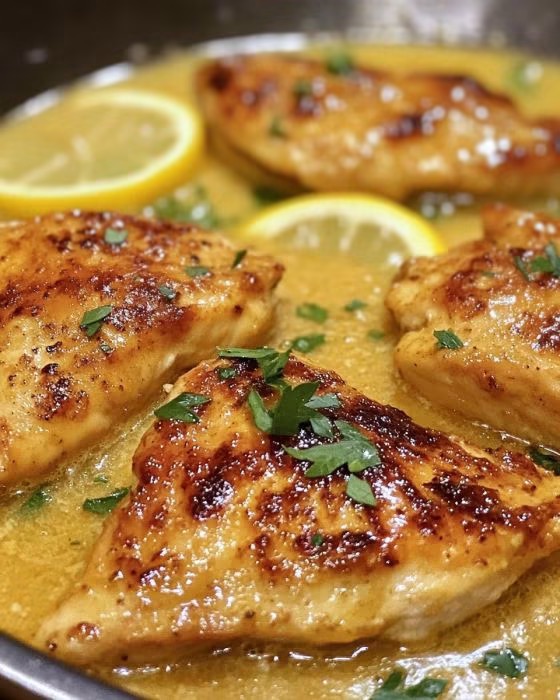
Thin chicken breasts seared until deep golden, then finished in a lemon butter pan sauce built from the browned bits left behind. One skillet, twenty-five minutes, and a sauce with real depth from almost nothing extra.
The technique that decides everything is pounding the chicken to an even thickness before it goes anywhere near the pan. A whole chicken breast is thick at one end and thin at the other, so cooked as is, the thin end is dry and overdone by the time the thick end reaches temperature. Five minutes with a mallet fixes the entire recipe before it starts.
Ten minutes of prep, fifteen at the stove, and it comes together in one pan.
Why You Will Love This Recipe
The sauce comes from the pan itself. No separate saucepan and no wasted flavour left behind after searing.
It cooks in under fifteen minutes. Thin, even chicken sears fast, and the sauce reduces in the same window.
Restaurant results from a short ingredient list. Butter, lemon, garlic, and broth carry the whole dish.
It is naturally low carb. No flour-thickened sauce, no starch, just butter and reduction.
It reheats without drying out. The sauce protects the chicken, so leftovers stay tender.
Recipe Overview
Prep time: 10 minutes
Cook time: 15 minutes
Total time: 25 minutes
Yield: 4 servings
Difficulty: Easy
Best for: Weeknight dinners, entertaining, low-carb meals
Ingredients
For the chicken
• 4 boneless skinless chicken breasts
• ½ teaspoon salt
• ½ teaspoon black pepper
• ½ teaspoon paprika
• ¼ teaspoon garlic powder
• 2 tablespoons olive oil
For the lemon butter sauce
• 3 tablespoons butter
• 3 cloves garlic, minced
• ¾ cup chicken broth
• ⅓ cup fresh lemon juice, about 2 lemons
• 1 lemon, thinly sliced
• 1 teaspoon honey
• 2 tablespoons chopped fresh parsley
• Salt and pepper to taste
Choosing the Right Chicken
The cut and its preparation matter as much as the sauce.
Chicken breasts, pounded thin. The right choice, and what is shown here. Even thickness means even cooking and a fast sear.
Pre-cut chicken cutlets. A convenient shortcut that skips the pounding step entirely, though they vary more in thickness than hand-pounded ones.
Bone-in chicken breasts. Not suited to this method. They need far longer to cook through and the sauce would reduce away before they finish.
Chicken thighs, boneless. A good substitute with more forgiving fat content, though the sauce and timing both need adjusting since thighs take a little longer.
Frozen chicken breasts. Thaw completely first. Pounding partially frozen chicken tears the meat rather than flattening it evenly.
Buy breasts of similar size if you are pounding your own, so all four finish cooking at roughly the same time.
Why Pounding the Chicken and Deglazing the Pan Both Matter
A chicken breast tapers from about an inch and a half at the thick end to under half an inch at the thin end. Heat moves through meat at a fairly constant rate, so in a pan cooking to a single internal temperature, the thin end reaches doneness first, and often significantly before the thick end. Left in the pan until the thick end catches up, the thin end dries out and toughens.
Pounding to an even half-inch removes that gap. Every part of the breast reaches 165°F within moments of every other part, which means a shorter total cooking time and no dry sections. It also tenderises slightly by breaking up some of the muscle fibre, which is a secondary benefit on top of the even cooking.
The sauce depends on what is left in the pan after searing. Browned proteins and sugars from the chicken stick to the metal during the sear, and that fond carries concentrated flavour that plain butter and lemon juice do not have on their own. Deglazing with broth lifts it back into the liquid, and reducing that liquid by roughly a third concentrates it into a sauce with real backbone rather than a thin lemon butter that tastes only of lemon and butter.
How to Make Skillet Lemon Butter Chicken
Step 1: Pound the chicken
Place each breast between two sheets of plastic wrap and pound to an even ½-inch thickness with a meat mallet or rolling pin.
Work from the centre outward. Even thickness is the entire point of this step.
Step 2: Season
Pat the chicken dry and season both sides with salt, pepper, paprika, and garlic powder.
Dry surfaces brown. Wet chicken steams instead of searing.
Step 3: Sear the chicken
Heat the olive oil in a large skillet over medium-high heat. Sear the chicken 3 to 4 minutes per side, until deep golden and cooked through.
Work in batches if it does not all fit without crowding. Crowded chicken steams rather than sears.
Step 4: Rest the chicken
Transfer to a plate and tent loosely with foil while you make the sauce.
Step 5: Build the base
Lower the heat to medium, add the butter to the same skillet, and once melted add the garlic. Cook 30 seconds until fragrant.
Step 6: Deglaze
Pour in the chicken broth, scraping up the browned bits from the bottom of the pan with a wooden spoon.
This is where the flavour comes from. Do not skip the scraping.
Step 7: Add the lemon
Stir in the lemon juice, lemon slices, and honey. Simmer 4 to 5 minutes, until reduced by about a third and slightly thickened.
The honey balances the acidity. Without it the sauce tastes sharp rather than bright.
Step 8: Return the chicken
Nestle the chicken back into the sauce along with any juices from the plate, and spoon the sauce over the top. Simmer 2 minutes to warm through.
Step 9: Finish and serve
Stir in the parsley, taste and adjust the salt and pepper, and serve straight from the skillet.
Tips for the Best Lemon Butter Chicken
Pound to an even thickness without exception. This single step prevents more dry chicken than anything else in the recipe.
Do not move the chicken too soon. Let it sear undisturbed for the first two minutes so a proper crust forms before you flip it.
Use fresh lemon juice. Bottled juice lacks the brightness and has a flatter, slightly bitter aftertaste once reduced.
Scrape the pan thoroughly. Every bit of fond that lifts into the sauce is flavour you would otherwise lose.
Rest the chicken briefly before serving. A couple of minutes lets the juices settle back into the meat.
Easy Variations
• Add a splash of white wine with the broth for more depth
• Stir in 2 tablespoons of capers for a piccata-style version
• Add ¼ cup of heavy cream at the end for a richer, creamier sauce
• Use chicken thighs and extend the sear to 5 to 6 minutes per side
• Add sliced mushrooms to the pan before deglazing
• Finish with a handful of baby spinach stirred in until wilted
What to Serve With It
Mashed potatoes, rice, or buttered egg noodles all catch the sauce, which is the main consideration here. A crusty piece of bread does the same job if you want something simpler.
For a vegetable, asparagus, green beans, or a light arugula salad with lemon vinaigrette all complement the citrus without competing with it.
Make-Ahead and Storage
Make ahead. Pound and season the chicken up to a day in advance and keep covered in the fridge. Cook fresh.
Fridge. Store in the sauce in an airtight container for up to 3 days.
Freezer. Freeze cooked chicken in the sauce for up to 2 months. The sauce may need a whisk after thawing to re-emulsify.
Reheating. Warm gently in a covered skillet over low heat with a splash of broth, or a 325°F oven for 15 minutes. Avoid the microwave on high, which toughens chicken quickly.
Frequently Asked Questions
Can I use chicken thighs instead?
Yes. They are more forgiving of slightly uneven thickness and take about a minute longer per side to sear through.
Why is my sauce too thin?
It likely needs more reduction time. Simmer it a few extra minutes before returning the chicken to the pan.
Can I make this dairy free?
Substitute a neutral oil or dairy-free butter alternative for the butter. The sauce will be slightly less rich but still works.
Why did my chicken turn out dry?
Almost always uneven thickness. Pounding to a consistent half inch is what prevents the thin end from overcooking.
Can I use bottled lemon juice?
You can in a pinch, but fresh juice gives a noticeably brighter, cleaner flavour once the sauce reduces.
Is this dish very tart?
The honey balances the lemon into a bright but rounded sauce rather than a sharp one. Adjust the honey up slightly if you prefer it milder.
Nutrition Information
• Calories: 320 per serving
• Protein: 36g
• Fat: 17g
• Carbohydrates: 6g
• Fiber: 4g
• Sodium: 480mg
Nutrition is estimated and will vary with portion size and brands used.
Final Thoughts
Two rules carry this dish. Pound the chicken to an even thickness before it sees the pan, and scrape up every bit of browned fond when you deglaze. The first prevents dry chicken and the second is where the sauce gets its depth.