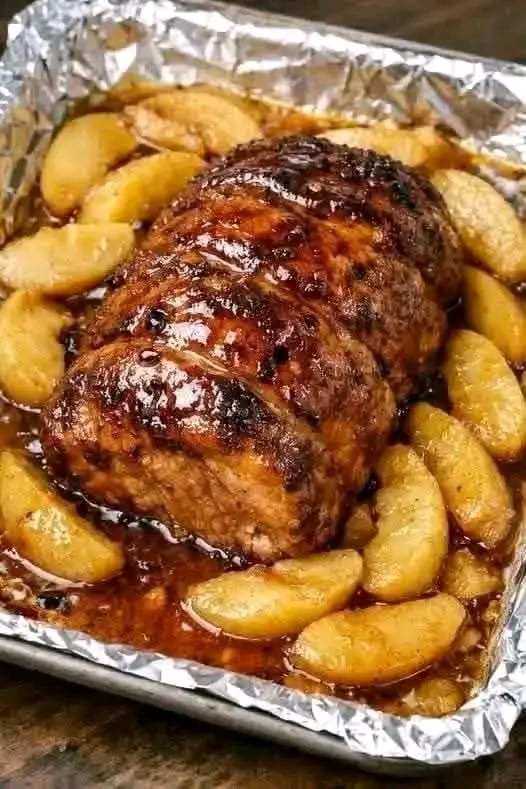
This pork loin is roasted with apple wedges around it and brushed with an apple cider glaze in the last twenty minutes, which is what produces the dark lacquered surface in the photo. The apples soften into the pan juices and become the sauce.
The critical detail is temperature. Pork loin is a lean cut with almost no fat running through it, and the difference between juicy and dry is about ten degrees on a thermometer.
Everything happens on one foil-lined sheet pan, so there is essentially nothing to wash afterwards.
Why You Will Love This Recipe
The glaze does the work. Apple cider, brown sugar, and mustard reduce into something that browns dramatically without any technique.
It serves eight from one cut. Pork loin is among the cheapest roasts per serving and slices neatly.
Sides cook in the same pan. The apples go in with the roast and come out as both vegetable and sauce.
Foil lining means no scrubbing. Sugar glaze burns onto a bare pan and takes serious effort to remove.
It looks like a holiday centrepiece. Whole, glazed, and surrounded by apples, it presents far above its cost.
Recipe Overview
Prep time: 20 minutes
Roast time: 60 to 75 minutes
Rest time: 15 minutes
Total time: About 1 hour 50 minutes
Yield: 8 servings
Difficulty: Easy
Best for: Sunday dinner, holidays, autumn meals, entertaining
Ingredients
For the Pork
• 3 to 4 pound boneless pork loin roast
• 2 teaspoons kosher salt
• 1 teaspoon coarsely ground black pepper
• 1 teaspoon garlic powder
• 1 teaspoon dried thyme
• 2 tablespoons olive oil
For the Apples
• 4 firm apples such as Honeycrisp or Granny Smith, cored and cut into thick wedges
• 2 tablespoons unsalted butter, melted
• 1 tablespoon brown sugar
• 1/4 teaspoon ground cinnamon
For the Apple Glaze
• 3/4 cup (180 ml) apple cider or unsweetened apple juice
• 1/3 cup (75 g) packed brown sugar
• 2 tablespoons Dijon mustard
• 2 tablespoons apple cider vinegar
• 1 tablespoon soy sauce
• 2 cloves garlic, minced
• 1/4 teaspoon black pepper
Choosing the Right Cut
Pork loin is what this recipe is written for. It is a wide, lean roast from the back of the animal, usually with a thin fat cap on one side.
Pork tenderloin is a different cut entirely. It is a small, narrow muscle weighing about a pound, and it cooks in 20 to 25 minutes. Using this recipe’s timing on a tenderloin will ruin it.
Bone-in pork loin roast works well and is more forgiving, since the bone moderates the heat. Add about 15 minutes to the roasting time.
Pork shoulder is not a substitute. It needs hours of low heat to break down and will be tough at this temperature and timing.
Leave the fat cap on. Score it in a diamond pattern about a quarter inch deep. It bastes the roast as it renders and holds the glaze well.
Why 145°F Is the Number That Matters
Pork loin is roughly as lean as chicken breast, and it dries out just as fast.
The USDA lowered the recommended temperature for whole pork cuts to 145°F followed by a three-minute rest. The old advice of 160°F dates from a period when trichinosis was a genuine concern and is no longer necessary.
The difference is dramatic. At 145°F the meat is faintly pink at the centre and juicy. At 160°F it is uniformly white, firm, and noticeably dry.
Carryover cooking adds 5 to 10 degrees. Pull the roast at 140°F and it will reach 145°F while resting. This is not optional with a lean cut.
Use an instant-read thermometer in the thickest part. Timing charts are estimates and vary with the shape of the roast, not just its weight.
How to Make Apple Glazed Pork Loin
Step 1: Bring the pork to room temperature
Take the roast out of the refrigerator 30 to 45 minutes before cooking. A cold centre means the outside overcooks while the middle catches up.
Step 2: Season it
Preheat the oven to 375°F (190°C) and line a rimmed sheet pan with foil.
Pat the pork completely dry. Rub it all over with olive oil, then with the salt, pepper, garlic powder, and thyme.
Step 3: Sear it
Heat a large skillet over medium-high heat and sear the roast for 2 to 3 minutes per side, including the ends, until browned all over.
Searing is worth the eight minutes. It builds a crust the glaze can grip and adds flavour the oven cannot.
Step 4: Make the glaze
In a small saucepan, combine the cider, brown sugar, Dijon, vinegar, soy sauce, garlic, and pepper. Simmer over medium heat for 8 to 10 minutes, until reduced by about a third and syrupy enough to coat a spoon.
Step 5: Set up the pan
Place the seared roast fat side up in the centre of the foil-lined pan.
Toss the apple wedges with the melted butter, brown sugar, and cinnamon, and scatter them around the roast in a single layer.
Step 6: Roast
Roast for 45 minutes without touching it.
Step 7: Start glazing
Brush the roast generously with the glaze and return it to the oven.
Repeat every 10 minutes, brushing two or three times total over the last 20 to 25 minutes. Each layer builds on the last.
Glazing from the start would burn the sugar over an hour. It belongs at the end.
Step 8: Check the temperature
Begin checking at 55 minutes. Pull the roast when the thickest part reads 140°F.
A 3 pound loin usually takes about 60 minutes, a 4 pound loin about 75, but shape matters more than weight.
Step 9: Rest, then slice
Transfer to a board and tent loosely with foil for 15 minutes. The internal temperature will rise to 145°F.
Slice against the grain into half-inch slices and serve with the apples and the pan juices spooned over.
Tips for the Best Pork Loin
Use a thermometer, not a timer. This is the single most important tip for any lean roast.
Pull it at 140°F. Carryover does the rest. Waiting until it reads 145°F in the oven means it finishes at 152°F or higher.
Rest for a full 15 minutes. Slicing early lets the juices run onto the board instead of staying in the meat.
Score the fat cap. It renders more evenly and the glaze sits in the cuts.
Use firm apples. Softer varieties collapse into sauce within 30 minutes.
Common Mistakes to Avoid
Confusing loin with tenderloin. The most consequential error possible here. Check the label and the weight.
Cooking to 160°F. Safe but dry. 145°F with a rest is the current guidance and produces far better meat.
Glazing too early. Sugar burns black over an hour at 375°F.
Skipping the rest. Up to a third of the juice ends up on the cutting board.
Slicing with the grain. Cuts the muscle fibres lengthwise and makes even a perfectly cooked roast feel chewy.
Easy Variations
• Maple glazed. Replace the brown sugar with 1/3 cup of maple syrup.
• With root vegetables. Add halved baby potatoes and thick carrot pieces alongside the apples.
• Herb crusted. Add 2 tablespoons of chopped fresh rosemary and sage to the rub.
• Spicy apple. Add 1/2 teaspoon of red pepper flakes and a tablespoon of hot honey to the glaze.
• Slow cooker. Sear, then cook on low for 4 to 5 hours with half the glaze, reducing the rest on the stove to finish.
• Stuffed. Butterfly the loin, spread with apple and onion stuffing, tie, and roast for the same time.
What to Serve With It
Mashed potatoes are the natural partner, and there are enough pan juices to justify them.
Roasted Brussels sprouts, green beans, or braised red cabbage all suit the apple and mustard flavours.
Wild rice, stuffing, or a herbed grain salad work for a more autumnal plate.
A sharp side helps. Pickled onions or a vinaigrette salad cut the sweetness of the glaze.
Make-Ahead and Storage
Make-ahead: Season the roast and refrigerate uncovered for up to 24 hours. This dries the surface and gives a better crust. The glaze keeps for a week refrigerated.
Refrigerator: Store sliced pork in its juices for up to 4 days. Keeping it in liquid is what prevents it drying out.
Freezer: Freeze sliced pork with some pan juices for up to 3 months.
To reheat: Warm covered at 300°F for 15 minutes with a splash of broth or cider. Low and slow, since reheated lean pork dries almost instantly at high heat.
Frequently Asked Questions
Is pink pork safe?
Yes. Whole cuts of pork are safe at 145°F with a three-minute rest, and a faint blush of pink at that temperature is normal and expected.
Can I use pork tenderloin instead?
Not with this timing. Tenderloin needs 20 to 25 minutes at 400°F. Use the same glaze but adjust everything else.
What apples hold up best?
Honeycrisp, Granny Smith, Braeburn, and Pink Lady. Avoid McIntosh and Red Delicious, which turn to mush.
Can I make the glaze without cider?
Yes. Use apple juice, or chicken broth with an extra tablespoon of vinegar for tartness.
Why is my pork dry?
Almost certainly overcooking. Ten degrees past 145°F makes a visible difference in a cut this lean.
Do I have to sear it first?
No, but the crust and colour are noticeably better with it. If you skip it, roast at 400°F for the first 15 minutes instead.
Nutrition Information
Approximate values per serving, based on 8 servings:
• Calories: 385
• Total fat: 14 g
• Saturated fat: 5 g
• Carbohydrates: 24 g
• Sugar: 19 g
• Protein: 40 g
• Sodium: 690 mg
Nutrition is estimated and will vary with trimming and portion sizes.
Final Thoughts
Apple glazed pork loin is a straightforward roast with two rules attached: buy the right cut, and pull it off the heat at 140°F.
Glaze it only in the last twenty minutes, let it rest a full fifteen, and slice against the grain. Those three decisions are the whole difference between this and the dry pork roast most people remember.