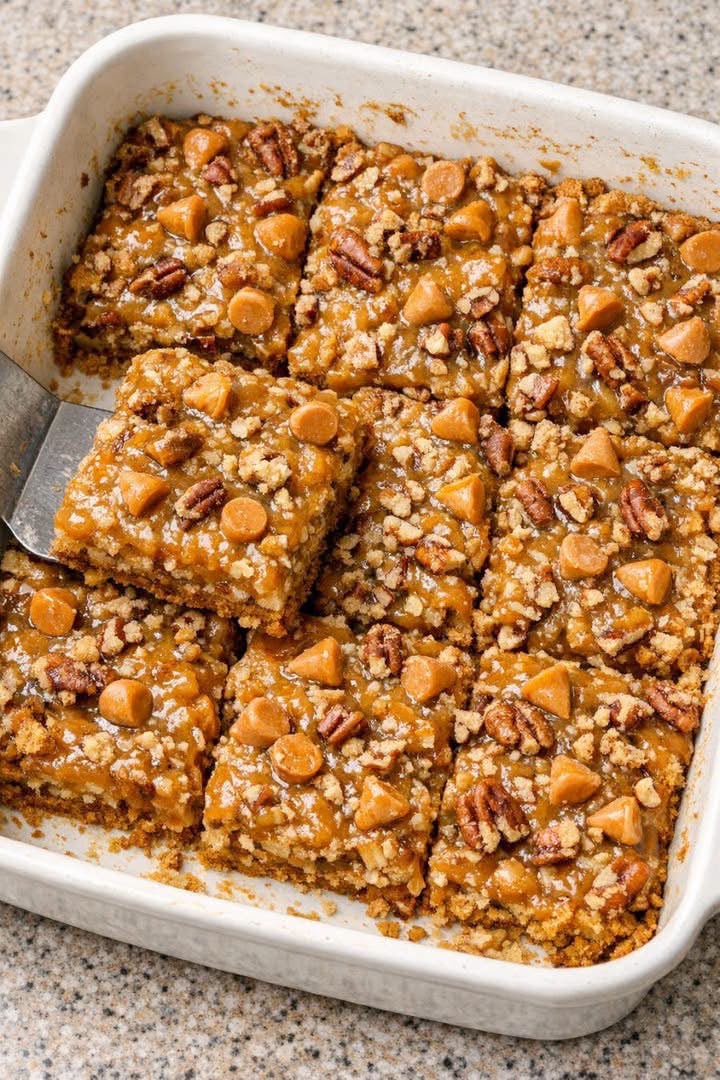
These bars are built in three layers in one pan: a pressed shortbread base, a caramel and butterscotch filling, and a streusel of pecans and butterscotch chips scattered over the top. They bake in a single stretch with no par-baking required.
The photo shows what a properly baked batch looks like at the edges: the caramel bubbles up around the streusel and sets into a glossy layer rather than staying runny. That distinction comes down to letting the pan cool completely.
They cut into nine or twelve squares depending on how rich you want each serving to be.
Why You Will Love These Bars
Three layers, one bake. No blind baking, no separate caramel pan, no chilling between stages.
The shortbread base is pressed, not rolled. It goes into the pan with your fingers in about a minute.
They hold their shape for days. The caramel sets firm enough to stack, unlike most sticky bars.
Butterscotch chips do the heavy lifting. They melt into the caramel and give the flavour without cooking sugar to temperature.
They freeze well. Cut, wrap, and take one out at a time.
Recipe Overview
Prep time: 20 minutes
Bake time: 35 to 40 minutes
Cool time: 2 hours
Total time: About 3 hours
Yield: 9 to 12 bars
Difficulty: Easy
Best for: Holidays, potlucks, gifting, autumn baking, coffee mornings
Ingredients
For the Shortbread Base
• 1/2 cup (115 g) unsalted butter, softened
• 1/2 cup (100 g) packed light brown sugar
• 1 1/4 cups (155 g) all-purpose flour
• 1/4 teaspoon kosher salt
For the Caramel Filling
• 1/2 cup (115 g) unsalted butter
• 3/4 cup (150 g) packed dark brown sugar
• 1/4 cup (60 ml) heavy cream
• 2 tablespoons light corn syrup or golden syrup
• 1 teaspoon vanilla extract
• 1/2 teaspoon kosher salt
For the Topping
• 1 cup (110 g) chopped pecans
• 3/4 cup (130 g) butterscotch chips
• 1/3 cup (40 g) all-purpose flour
• 2 tablespoons packed brown sugar
• 2 tablespoons unsalted butter, cold and cubed
Choosing the Right Ingredients
Dark brown sugar is the right choice for the caramel. Its higher molasses content is what gives butterscotch its characteristic flavour, and light brown sugar produces a noticeably flatter result.
Light brown sugar works better in the base, where you want tenderness rather than deep flavour.
Corn syrup or golden syrup prevents crystallization. Two tablespoons is enough to keep the caramel smooth rather than grainy. Honey can substitute but changes the flavour.
Real butterscotch chips vary widely in quality. Cheaper brands contain more palm oil and less butter, and they melt into a waxier layer. If your chips list oil before dairy, expect a slightly greasy top.
Pecans should be toasted first. Five minutes in a dry pan or eight in a 350°F oven doubles their flavour and takes almost no effort.
Walnuts are the obvious substitute. They are more bitter and less sweet, which some people prefer against the caramel.
Why the Base Is Pressed, Not Rolled
Shortbread dough for bars is deliberately drier and stiffer than cookie dough, and it is meant to be compacted rather than shaped.
Pressing compacts it evenly. Fingers or the flat bottom of a glass push the dough into a uniform layer with no air pockets, which is what stops the caramel soaking through in patches.
Rolling introduces problems. A rolled sheet has to be lifted into the pan, where it tears and leaves seams.
Press it firmly, not gently. A loosely pressed base crumbles when cut and lets caramel run underneath.
Chill it for ten minutes if your kitchen is warm. A cold base holds its structure better when the hot caramel goes on.
How to Make Butterscotch Pecan Bars
Step 1: Prepare the pan
Preheat the oven to 350°F (175°C). Line a 9×9 inch pan with a parchment sling, leaving overhang on two sides.
The overhang lets you lift the whole slab out. Cutting sticky caramel bars in the pan damages the first row every time.
Step 2: Make the base
Beat the softened butter and light brown sugar together for 1 minute, then stir in the flour and salt until a crumbly dough forms.
Step 3: Press it in
Tip the dough into the lined pan and press it into an even layer, working it firmly into the corners.
Prick it lightly with a fork in a few places. This lets steam escape and stops the base doming under the filling.
Step 4: Make the streusel topping
In a bowl, rub the cold cubed butter into the flour and brown sugar with your fingers until it looks like coarse crumbs.
Stir in the chopped toasted pecans and the butterscotch chips and set aside.
Step 5: Make the caramel
Melt the butter in a saucepan over medium heat. Add the dark brown sugar, cream, and syrup and stir until dissolved.
Bring to a simmer and cook for 3 to 4 minutes, stirring constantly, until slightly thickened and glossy.
Do not walk away. Brown sugar caramel scorches quickly and cannot be rescued once it does.
Remove from the heat and stir in the vanilla and salt.
Step 6: Assemble
Pour the hot caramel evenly over the unbaked shortbread base, tilting the pan to spread it into the corners.
Scatter the streusel and pecan mixture across the surface.
Step 7: Bake
Bake for 35 to 40 minutes, until the caramel is bubbling around the edges and the topping is golden.
The centre will still look loose. It sets as it cools, and baking until the middle looks firm gives you hard, chewy bars.
Step 8: Cool completely
Let the pan sit at room temperature for at least 2 hours.
This is the step people skip and the reason bars fall apart. Warm caramel has no structure.
Step 9: Lift and cut
Use the parchment to lift the slab onto a board and cut into 9 or 12 squares with a large sharp knife, wiping the blade between cuts.
Tips for the Best Bars
Toast the pecans. It is five minutes and the flavour difference is substantial.
Press the base firmly. A compacted base is what keeps the layers separate.
Watch the caramel constantly. Three to four minutes of stirring, then off the heat.
Underbake slightly. The centre should still look soft when the pan comes out.
Cool completely before cutting. Two hours minimum, and overnight is better.
Common Mistakes to Avoid
Cutting while warm. The caramel smears, the base crumbles, and the layers separate.
Baking until the centre is firm. This overbakes the caramel into something hard rather than chewy.
Skipping the corn syrup. Without it the caramel can crystallize into a grainy layer.
Using untoasted nuts. They taste soft and faintly raw against a strong caramel.
Cooling in the refrigerator. It sets the caramel too hard and makes the base brittle. Room temperature is correct.
Easy Variations
• Salted caramel. Sprinkle flaky sea salt over the topping as soon as the pan leaves the oven.
• Chocolate butterscotch. Replace half the butterscotch chips with semisweet chocolate chips.
• Oat streusel. Add 1/2 cup of rolled oats to the streusel for more texture.
• Bourbon. Add 1 tablespoon of bourbon to the caramel with the vanilla.
• Maple pecan. Replace the corn syrup with maple syrup and add 1/2 teaspoon of maple extract.
• 9×13 pan. Double everything and bake for 40 to 45 minutes for 24 bars.
What to Serve With Them
Coffee is the best match, since the bars are sweet enough that anything sweeter competes.
For dessert, a warm bar with vanilla ice cream and a little extra caramel works well.
On a holiday dessert table they sit comfortably alongside pecan pie, apple crisp, and gingerbread.
Cut them small when serving with other desserts. These are rich, and a two-inch square is plenty.
Make-Ahead and Storage
Make-ahead: Bake a day ahead. The bars cut most cleanly after a full night at room temperature and the caramel flavour deepens.
Room temperature: Store in an airtight container with parchment between layers for up to 5 days.
Refrigerator: Keeps for up to a week but hardens the caramel. Bring to room temperature before serving.
Freezer: Freeze cut bars wrapped individually for up to 3 months. Thaw at room temperature for an hour.
To reheat: Ten seconds in the microwave softens the caramel nicely if you like them warm.
Frequently Asked Questions
Why is my caramel grainy?
Sugar crystallized, usually because the corn syrup was omitted or the mixture was not stirred enough while dissolving.
Why did my bars fall apart when cutting?
They were still warm, or the base was not pressed firmly enough. Cool completely and press hard next time.
Can I use store-bought caramel sauce?
It is thinner and will not set the same way. If you use it, reduce it in a pan for a few minutes first.
Can I make them without corn syrup?
Yes, use golden syrup, honey, or maple syrup. All prevent crystallization, though each changes the flavour slightly.
Are butterscotch chips necessary?
They give the signature flavour. Without them you have caramel pecan bars, which are also good but different.
Can I double the recipe?
Yes, in a 9×13 pan with about 5 extra minutes. Do not stack two batches in one deep pan.
Nutrition Information
Approximate values per bar, based on 12 bars:
• Calories: 425
• Total fat: 25 g
• Saturated fat: 12 g
• Carbohydrates: 48 g
• Sugar: 33 g
• Protein: 4 g
• Sodium: 190 mg
Nutrition is estimated and will vary with brands and portion sizes.
Final Thoughts
Butterscotch pecan bars are three simple layers with one rule holding them together: pull the pan while the centre still looks loose, then leave it alone for two hours.