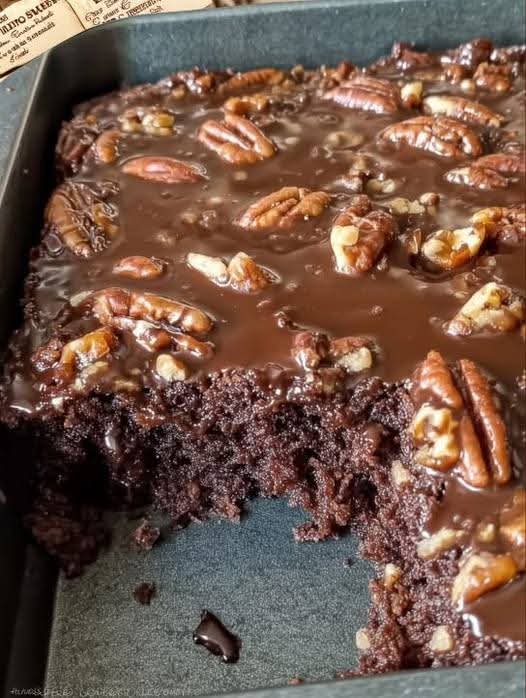
In the grand pantheon of American cakes, few can rival the sheer nostalgic power of a classic Texas Sheet Cake. It’s a paradox of a dessert: impossibly thin yet deeply rich, humble in its preparation yet triumphant in its flavor, and designed not for delicate tea parties but for bustling potlucks, church suppers, and family reunions where it vanishes in minutes. The cake itself is tender, moist, and infused with cocoa and a whisper of cinnamon, but the real magic lies in the glossy, fudge-like pecan frosting that’s poured over the warm cake, creating a thin, crackly layer that shatters delicately with every bite. Born in the Lone Star State and beloved across the South, this sheet cake is the ultimate crowd-pleaser—a true legend that delivers maximum chocolate impact with minimal fuss, all in a single pan.
What makes a Texas Sheet Cake so special isn’t just the flavor; it’s the entire experience. The cake batter comes together in a saucepan on the stovetop—no stand mixer required—by melting butter with cocoa and water, then stirring in flour, sugar, eggs, and sour cream. It’s poured into a large, shallow sheet pan (the “Texas” part refers to the size, befitting a state that does everything bigger), baked until just set, and then immediately drenched in a warm, pourable chocolate-pecan frosting that seeps into the cake’s surface, creating a fudgy, almost truffle-like top layer. The thinness of the cake—usually only about an inch thick—means it bakes quickly and the frosting-to-cake ratio is perfectly balanced. Every bite delivers that tender chocolate crumb, the rich, gooey frosting, and the crunchy, buttery pecans. It’s the cake that makes you close your eyes and sigh with contentment, and it’s the cake that will have everyone asking for the recipe before the pan is even scraped clean.
In this comprehensive guide, we’ll explore everything that makes the Texas Sheet Cake a timeless icon: the history behind its name, the science of that incredibly moist crumb, a step-by-step breakdown of the stovetop method, and the secrets to a smooth, crackly frosting that sets up perfectly. You’ll find variations for buttermilk, spice, and even white Texas sheet cake, plus tips for transporting and storing this beloved dessert. Whether you’re a born-and-raised Texan with a family recipe or a newcomer discovering this treasure for the first time, this guide will give you everything you need to bake a sheet cake worthy of its legendary reputation. Let’s get that saucepan on the stove and the cocoa ready—we’re about to make a cake that tastes like home.
Why You’ll Love This Texas Sheet Cake
Unbelievably moist and deeply chocolatey. The combination of melted butter, cocoa, and buttermilk or sour cream creates a cake that’s so tender it practically melts on your tongue. There’s no dry crumb here—the large amount of liquid and fat ensures a velvety, almost pudding-like texture that stays moist for days. The cocoa provides a rich, old-fashioned chocolate flavor that’s not too sweet and pairs beautifully with the cinnamon. It’s a chocolate lover’s dream, but it’s also incredibly approachable for those who prefer a more balanced, less intense chocolate experience.
The famous warm frosting that sets like magic. The frosting is what makes a Texas Sheet Cake instantly recognizable. It’s a boiled mixture of butter, cocoa, and milk, thickened with powdered sugar and studded with toasted pecans. While it’s still hot, it’s poured over the warm cake and spreads into a thin, glossy layer that seeps into the surface and then sets into a soft, fudge-like crust as it cools. This isn’t a thick, fluffy buttercream—it’s a thin, intensely chocolatey glaze that becomes one with the cake. The crackly top is what gives the sheet cake its signature texture contrast, and it’s utterly addictive.
Made in one saucepan, with no mixer required. This is a truly old-fashioned, low-tech recipe. The cake batter starts on the stovetop: you bring butter, cocoa, and water to a boil, then stir in the dry ingredients, followed by the eggs and sour cream. No creaming, no beating, no stand mixer to lug out and clean. The frosting is made the same way—in a saucepan, with a whisk. It’s the perfect recipe for beginner bakers, for those without a lot of equipment, or for anyone who wants a fantastic chocolate cake without the fuss. And because it’s all done in one pot (plus a bowl for dry ingredients), cleanup is minimal.
Feeds a crowd and travels perfectly. Baked in a large 13×18-inch half-sheet pan, this cake yields about 24 generous squares—making it the ultimate potluck, picnic, or party dessert. The cake is thin and sturdy, so it can be cut into neat pieces and served directly from the pan. It travels beautifully; you can even frost it at home and carry it to the gathering. It’s the cake you bring when you want to guarantee an empty pan and a flood of recipe requests. And because it’s so rich, a small square is deeply satisfying, so it really does feed a crowd.
A Slice of History: The Story Behind the Cake
The exact origins of Texas Sheet Cake are, like many beloved regional recipes, a bit hazy. Food historians generally trace its rise to the mid-20th century, with the recipe appearing in community cookbooks and newspaper columns across the South and Midwest. Some say it was a Texas invention, born of the need for a quick, portable cake that could feed ranch hands or large church congregations; others argue it may have originated with a chocolate sheet cake recipe published in a 1950s Dallas newspaper. What’s undisputed is that the cake became a staple at potlucks, funerals, and family gatherings throughout Texas and the surrounding states, earning its name through sheer popularity and the “everything’s bigger” spirit. The use of a large sheet pan—often called a “Texas sheet pan” in the era—solidified the connection.
One of the reasons this cake spread so quickly was its simplicity and reliance on pantry staples. In an era before electric mixers were universal, the stovetop method was accessible to everyone. The ingredients—butter, cocoa, flour, sugar, eggs, and sour cream or buttermilk—were inexpensive and widely available. The cake could be thrown together quickly, baked in a short time, and frosted while warm, saving precious minutes for busy homemakers. It was also a cake that could be made in hot climates without overheating the kitchen, since the oven time was brief. The addition of pecans, a Southern staple, further rooted it in the region. Over the decades, the recipe has been passed down on stained index cards, tweaked with cinnamon or extra vanilla, and adapted for different pan sizes. Today, it remains a beloved classic that connects generations through a shared love of simple, delicious chocolate cake.
Ingredient Deep Dive: The Cake and Frosting Essentials
Understanding the role of each ingredient will help you achieve the perfect Texas Sheet Cake and allow you to make smart substitutions when needed.
For the Cake
Unsalted Butter: Two sticks (1 cup) of unsalted butter form the rich, flavorful foundation. You’ll melt it with cocoa and water to create the liquid base. Using unsalted butter allows you to control the salt level. The butter also contributes to the cake’s tender crumb and moistness. If you only have salted butter, reduce the added salt in the recipe by about ¼ teaspoon.
Unsweetened Cocoa Powder: A quarter cup of unsweetened natural cocoa powder (not Dutch-process) gives the cake a deep, classic chocolate flavor. Natural cocoa is slightly acidic, which reacts with the baking soda and buttermilk to create a light, tender texture. If you use Dutch-process cocoa, the cake may not rise as well and will have a mellower, less sharp chocolate taste. Both work, but natural cocoa is traditional.
Water: One cup of water is boiled with the butter and cocoa. This step dissolves the cocoa, blooms its flavor, and creates a hot liquid that helps the sugar dissolve and the flour hydrate quickly. Some recipes use brewed coffee instead of water to intensify the chocolate flavor; you can substitute an equal amount of strong black coffee for a deeper, more complex taste.
All-Purpose Flour: Two cups of all-purpose flour give the cake structure. The batter is quite thin, but the flour sets up during baking to form a tender, slightly dense crumb. Measure the flour carefully by spooning it into the measuring cup and leveling it off. For a gluten-free version, a 1:1 gluten-free flour blend works well.
Granulated Sugar: Two cups of white sugar provide sweetness and moisture. The sugar is dissolved in the hot liquid, which contributes to the cake’s smooth texture. Do not reduce the sugar significantly, as it also provides structure and tenderness. For a slightly deeper flavor, you can substitute ½ cup of brown sugar for the granulated.
Sour Cream or Buttermilk: Half a cup of sour cream (or buttermilk) adds a tangy richness and incredible moisture. The acidity reacts with the baking soda, helping the cake rise. Sour cream creates a slightly denser, richer cake; buttermilk gives a slightly lighter texture. Both are traditional and delicious. If you don’t have either, you can make a quick substitute by adding 1 teaspoon of lemon juice or vinegar to ½ cup of regular milk and letting it sit for 5 minutes. Plain full-fat Greek yogurt also works well. The dairy should be at room temperature for the best emulsion.
Eggs: Two large eggs, at room temperature, provide structure and richness. They’re beaten in at the end, after the hot liquid has cooled slightly, to prevent scrambling. If the batter is too hot, the eggs can cook and create lumps; let the butter-cocoa mixture cool for a few minutes before adding the eggs. The eggs also contribute to the cake’s tender crumb.
Baking Soda, Salt, and Cinnamon: One teaspoon of baking soda provides the leavening, reacting with the sour cream and cocoa to give the cake its characteristic light crumb. A half teaspoon of salt enhances the chocolate flavor. A half teaspoon of ground cinnamon is a classic addition that adds a subtle warmth—it’s not overpowering and many people are surprised to learn it’s in the cake, but it gives an unmistakable depth. You can omit the cinnamon if you prefer a pure chocolate flavor, but the hint of spice is traditional.
For the Frosting
Unsalted Butter: Half a cup (1 stick) of butter, melted with cocoa and milk, forms the glossy base. The butter provides richness and helps the frosting set with a slight sheen. Using unsalted butter allows you to control the saltiness, but salted butter can be used if you reduce any additional salt.
Unsweetened Cocoa Powder: Three tablespoons of cocoa powder give the frosting its deep chocolate flavor. You can use either natural or Dutch-process here; both work well. The cocoa is dissolved in the hot butter mixture, blooming its flavor.
Milk: Five to six tablespoons of whole milk (or half-and-half for extra richness) thin the frosting to a pourable consistency. The exact amount can vary depending on the humidity and the cocoa; you want the frosting to be fluid enough to spread easily but thick enough to set into a soft, fudge-like layer on the cake. Add the milk gradually until you reach the desired texture.
Powdered Sugar: Three and a half cups of sifted powdered sugar sweeten and thicken the frosting. The powdered sugar dissolves smoothly, creating a silky texture. Sifting it before adding prevents lumps. If you want a slightly less sweet frosting, you can reduce the powdered sugar by ½ cup, but the frosting will be thinner and may not set as firmly. This is not a thick buttercream; it’s meant to be a pourable glaze that sets into a thin, crackly layer. The high sugar content is what creates that signature crackly top as it cools.
Vanilla Extract and Pecans: One teaspoon of pure vanilla extract adds a warm, aromatic note that rounds out the chocolate flavor. One cup of chopped pecans, toasted if desired, provides the classic nutty crunch that’s synonymous with Texas Sheet Cake. Toasting the pecans in a dry skillet for a few minutes intensifies their flavor and adds a deeper nuttiness. The pecans are stirred into the frosting just before pouring, so they’re suspended throughout. If you’re not a fan of pecans, you can substitute walnuts or omit the nuts entirely, but the pecans are a defining characteristic of the traditional cake.
Step-by-Step: From Stovetop to Sheet Pan
This recipe is wonderfully straightforward. Follow these detailed steps for a classic Texas Sheet Cake that’s moist, tender, and perfectly frosted.
Step 1: Preheat and Prepare the Pan
Preheat your oven to 350°F (175°C). Grease a 13×18-inch half-sheet pan (with a 1-inch rim) with butter or nonstick spray. If you don’t have a half-sheet pan, you can use a 9×13-inch pan for a thicker cake; the baking time will be longer (about 35–40 minutes). For a half-sheet pan, the cake will be about 1 inch thick. Dust the greased pan lightly with flour or cocoa powder, tapping out the excess, or simply line it with parchment paper for easy lifting. Set aside.
Step 2: Boil the Butter, Cocoa, and Water
In a large saucepan (at least 3 quarts), combine the 2 sticks of butter, ¼ cup cocoa powder, and 1 cup of water. Place the pan over medium heat and bring the mixture to a gentle boil, stirring occasionally, until the butter is completely melted and the cocoa is dissolved. The liquid will be glossy and dark. As soon as it reaches a boil, remove the pan from the heat. Let it cool for 2–3 minutes. This brief cooling prevents the eggs from scrambling when they’re added later.
Step 3: Add the Dry Ingredients
While the butter mixture cools slightly, whisk together the flour, sugar, baking soda, salt, and cinnamon in a large bowl. This premixing ensures the leavening and salt are evenly distributed. Gradually add the dry ingredients to the warm butter mixture in the saucepan, stirring with a wooden spoon or whisk until the batter is smooth and well combined. The mixture will be thick but pourable. There’s no need to beat—just stir until uniform.
Step 4: Beat in the Eggs and Sour Cream
Add the 2 eggs, one at a time, beating well after each addition. Then stir in the sour cream (or buttermilk) and the vanilla extract. Whisk until the batter is completely smooth and glossy. The batter will be thin—this is normal. It should be about the consistency of heavy cream. Pour the batter into the prepared sheet pan, using a spatula to spread it evenly into the corners. The pan will be only partially filled; the cake will rise slightly but will still be thin.
Step 5: Bake Until Just Set
Place the sheet pan in the preheated oven and bake for 18 to 22 minutes, until a toothpick inserted in the center comes out clean or with just a few moist crumbs. The cake should be lightly springy to the touch and pulling away slightly from the edges. Do not overbake—the cake is thin and can dry out quickly. Start checking at the 18-minute mark. While the cake bakes, begin preparing the frosting so it’s ready to pour over the warm cake.
Step 6: Make the Frosting
In a medium saucepan (you can use the same one, wiped clean), combine the ½ cup butter, 3 tablespoons cocoa powder, and 5 tablespoons of milk. Bring to a gentle boil over medium heat, stirring constantly. Once it reaches a boil, remove from the heat. Add the sifted powdered sugar, vanilla extract, and a pinch of salt if desired. Whisk vigorously until the frosting is completely smooth and glossy. Stir in the chopped pecans. The frosting should be thick but pourable. If it’s too thick, add an additional tablespoon of milk, a little at a time, until the consistency is like warm honey. The frosting needs to be spreadable but not runny.
Step 7: Frost the Warm Cake
As soon as the cake comes out of the oven, place it on a heatproof surface. Immediately pour the warm frosting over the hot cake, using a spatula to gently spread it evenly to the edges. Work quickly but gently; the frosting will begin to set as it touches the warm cake. The thin layer of frosting will partially sink into the top of the cake, creating that signature fudgy, integrated surface. Sprinkle a few extra chopped pecans over the top if desired. Let the cake cool completely in the pan on a wire rack. As it cools, the frosting will set into a thin, slightly crackly layer. This will take about 1–2 hours. Once completely cool, cut into squares and serve directly from the pan.
Pro Tips for the Perfect Cake and Frosting
- Use a true half-sheet pan for the classic thin cake. A 13×18-inch pan with a 1-inch rim is the standard size. The batter will be very thin, about ¼ to ½ inch in the pan, but it will rise to about 1 inch. If you use a smaller pan, the cake will be thicker and require a longer baking time; adjust accordingly. A thicker cake is still delicious, but the thin cake has the ideal frosting-to-cake ratio. You can also use a jelly roll pan (15×10 inches) for a slightly thicker cake; bake for about 20–25 minutes.
- Pour the frosting over the cake while both are still warm. This is the defining technique of a Texas Sheet Cake. The heat from the cake helps the frosting spread easily and allows it to seep slightly into the surface, creating a fudgy, unified layer. If you let the cake cool completely before frosting, the frosting will sit on top and won’t have that signature texture. The frosting itself should also be warm and pourable; if it cools and thickens, reheat it gently on the stovetop, adding a splash of milk to loosen it.
- Sift the powdered sugar for a smooth frosting. Lumpy powdered sugar will create lumps in the frosting that are difficult to whisk out. Take a minute to sift it through a fine-mesh sieve before adding it to the hot butter mixture. This small step ensures a silky, professional-looking finish. If you don’t have a sifter, whisk the powdered sugar in a bowl to break up clumps before measuring.
- Toast the pecans for deeper flavor. Spread the chopped pecans on a dry baking sheet and toast in the oven at 350°F for 5–7 minutes, shaking once, until fragrant and slightly darkened. Let them cool before adding to the frosting. Toasting brings out their natural oils and adds a rich, nutty depth that complements the chocolate beautifully. This step is optional but highly recommended, as it elevates the entire cake.
- Work quickly but gently when spreading the frosting. The frosting starts to set as it cools, and the warm cake will hasten the process. Pour the frosting in ribbons over the surface, then use an offset spatula to gently coax it to the edges. Don’t press down hard; you want the frosting to remain on top, not be pushed into the cake. If you need to move quickly, have all your frosting ingredients measured and ready before the cake comes out of the oven.
Flavor Twists & Regional Variations
While the classic chocolate-pecan version is iconic, the Texas Sheet Cake format is endlessly adaptable. Here are a few beloved variations.
- White Texas Sheet Cake (Vanilla-Almond): Replace the cocoa in the cake with an additional ¼ cup of flour, and use clear vanilla or almond extract. The frosting is made with butter, milk, powdered sugar, and vanilla or almond flavoring, omitting the cocoa. This version is sometimes called “White Texas Sheet Cake” or “Almond Joy Sheet Cake” and is often topped with slivered almonds or flaked coconut. It’s a lovely alternative for non-chocolate lovers, and it’s stunning on a dessert table.
- Spiced Mexican Chocolate Sheet Cake: Increase the cinnamon to 1 teaspoon, and add ¼ teaspoon of cayenne pepper or chili powder to the cake batter. The gentle heat amplifies the chocolate flavor in the most incredible way, reminiscent of Mexican hot chocolate. Keep the frosting classic, or add a pinch of cinnamon to it as well. This version is a favorite for those who like a little kick, and it’s especially popular in South Texas.
- Peanut Butter Sheet Cake: For the cake, reduce the cocoa by half and add ¼ cup of creamy peanut butter to the hot butter mixture. For the frosting, stir ½ cup of peanut butter into the warm butter-cocoa mixture, and top with chopped peanuts instead of pecans. This variation tastes like a giant peanut butter cup and is a massive hit with kids. Drizzle with melted chocolate for extra decadence.
- Coconut Pecan Sheet Cake: Add ½ cup of sweetened shredded coconut to the cake batter along with the dry ingredients. For the frosting, stir in ½ cup of toasted coconut along with the pecans. The coconut adds a chewy, tropical note that pairs beautifully with the chocolate. You can also use coconut extract in the cake and frosting for an even more pronounced coconut flavor. This version is reminiscent of a German chocolate cake in sheet form.
- Espresso Chocolate Sheet Cake: Replace the water in the cake with an equal amount of strong brewed coffee or espresso. The coffee doesn’t make the cake taste like coffee; it deepens and intensifies the chocolate flavor, making it taste richer and more complex. This is a great trick for any chocolate baked good. Add a teaspoon of espresso powder to the frosting for an extra punch.
Serving & Transporting Your Sheet Cake
Texas Sheet Cake is a natural-born traveler. Since it’s served directly from the pan, it’s easy to cover with a lid or plastic wrap and carry to a potluck, church supper, or family reunion. If you want to present it beautifully, you can lift the entire cooled cake out of the pan using the parchment paper overhang (if you lined the pan) and transfer it to a large cutting board, then slice into squares and arrange on a platter. The cake cuts cleanly and holds its shape well. For a party, cut the cake into small squares—it’s very rich, and a 2-inch square is a satisfying serving. This cake is wonderful served at room temperature, but a slight chill can make the frosting extra fudgy. It’s equally delicious with a cup of black coffee, a glass of cold milk, or a scoop of vanilla ice cream on the side. If you’re serving it for a holiday, a sprinkle of festive sprinkles or a dusting of extra powdered sugar on the frosted cake can add a celebratory touch. Leftovers are excellent for breakfast the next day—just saying.
Want the full recipe and simple step-by-step instructions?
Page 2 continues with the full ingredients, cooking tips, and easy directions so you can make this recipe perfectly at home.