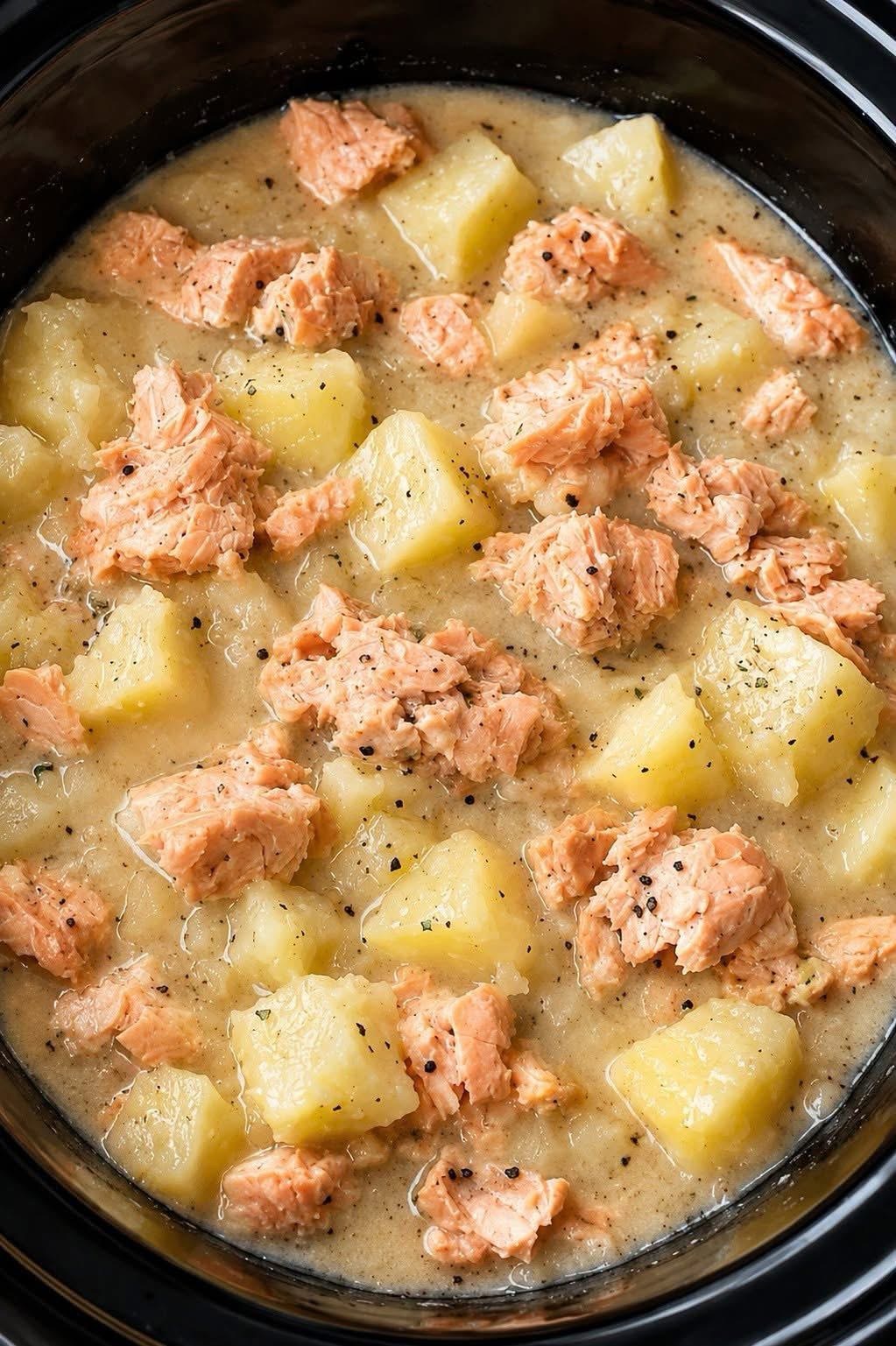
Salmon chowder in a slow cooker works on one condition: the salmon goes in at the end, not the beginning. Eight hours of gentle heat turns potatoes creamy and turns salmon into grey shreds, so the two cannot share a cooking time.
The method here builds the potato base slowly, then adds cubed salmon for the final thirty minutes. The fish poaches in the hot broth and comes out in the firm, coral-pink chunks you can see in the photo, still holding their shape.
The cream goes in at the end too, for the same reason. Dairy held at slow cooker temperatures for hours will separate.
Why You Will Love This Recipe
The salmon stays intact. Thirty minutes of poaching instead of eight hours of stewing is the entire difference.
It is a full meal in one pot. Protein, starch, and vegetables, no sides required.
The potatoes thicken it naturally. Some of the starch breaks down into the broth, so the chowder body comes from the vegetables rather than a flour roux.
It works with frozen salmon. No thawing required if you add it frozen with a slightly longer finish.
Ready when you get home. The base cooks unattended, and the last steps take about thirty minutes.
Recipe Overview
Prep time: 20 minutes
Base cook time: 6 to 7 hours on low, or 3 to 4 hours on high
Finish time: 30 minutes
Total time: About 7 hours
Yield: 6 servings
Difficulty: Easy
Best for: Cold weather, weeknight dinners, meal prep, Lent, casual entertaining
Ingredients
For the Base
• 2 pounds (900 g) Yukon Gold potatoes, peeled and cut into 3/4-inch cubes
• 1 large yellow onion, diced
• 2 celery stalks, diced
• 3 cloves garlic, minced
• 4 cups (960 ml) chicken or seafood broth
• 2 tablespoons unsalted butter
• 1 teaspoon dried dill
• 1 teaspoon kosher salt
• 1/2 teaspoon black pepper
• 1 bay leaf
For Finishing
• 1 1/2 pounds (680 g) skinless salmon fillet, cut into 1 1/2-inch cubes
• 1 cup (240 ml) heavy cream or half-and-half
• 2 tablespoons cornstarch, optional
• 1 tablespoon fresh lemon juice
• 2 tablespoons chopped fresh dill or parsley
• Salt and black pepper to taste
Optional Additions
• 4 slices bacon, cooked and crumbled
• 1 cup corn kernels
• 1/2 teaspoon smoked paprika
Choosing the Right Salmon
Fresh skinless fillet is the best option. Cut it into generous cubes, since smaller pieces flake apart during poaching.
Frozen salmon works well and is often better value. Add it frozen and increase the finishing time to about 45 minutes, or thaw it overnight first.
Farmed Atlantic salmon holds together slightly better than wild, because the higher fat content keeps it moist through the poach.
Wild sockeye and coho are leaner and firmer, with a stronger flavour and deeper colour. They overcook faster, so check them at 25 minutes.
Canned salmon is a legitimate shortcut. Drain two 14-ounce cans, remove any large bones, and stir it in during the last 10 minutes only, since it is already cooked.
Avoid smoked salmon here. The cure and smoke overwhelm the mild chowder and the texture turns unpleasantly firm.
Why Cream and Fish Both Go In Last
Dairy separates under prolonged heat. Cream held at slow cooker temperature for hours breaks into grainy curds and a thin liquid. Adding it in the final thirty minutes avoids that entirely.
Fish cooks in minutes, not hours. Salmon is done at 145°F, and it reaches that temperature in a hot broth in about 20 to 30 minutes. Beyond that the muscle fibres contract and squeeze out moisture.
The base needs the long cook, but the finish does not. Potatoes, onion, and celery genuinely benefit from hours of gentle heat. Nothing else in the pot does.
You can see the difference. Salmon added at the start comes out pale, shredded, and dispersed through the broth. Salmon added at the end sits in distinct pink chunks.
This same logic applies to any slow cooker seafood recipe. Shrimp, scallops, and white fish all go in at the very end.
How to Make Slow Cooker Salmon Chowder
Step 1: Load the base
Add the potatoes, onion, celery, garlic, broth, butter, dried dill, salt, pepper, and bay leaf to the slow cooker and stir once.
Cut the potatoes to an even size. Mixed sizes leave you with some pieces disintegrating while others stay firm.
Step 2: Cook the base
Cover and cook on low for 6 to 7 hours, or on high for 3 to 4 hours, until the potatoes are fully tender and pierce easily with a fork.
Step 3: Thicken it lightly
Remove the bay leaf. Using a potato masher, crush about a quarter of the potatoes directly against the side of the pot and stir.
This releases starch and thickens the chowder without flour. If you prefer it thicker still, whisk the cornstarch into 3 tablespoons of cold water and stir it in now.
Step 4: Switch to high
Turn the cooker to high. The broth needs to be genuinely hot before the salmon goes in, or the fish will sit at a lukewarm temperature for too long.
Step 5: Add the salmon
Scatter the salmon cubes evenly across the surface and press them gently under the liquid.
Do not stir. Stirring at this stage breaks the cubes apart before they have firmed up.
Step 6: Poach
Cover and cook for 20 to 30 minutes, until the salmon is opaque throughout and reaches 145°F at the centre of the largest piece.
Frozen salmon will need closer to 45 minutes.
Step 7: Add the cream
Pour in the cream and stir it through very gently with a silicone spatula, folding rather than stirring.
Let it warm through for 5 minutes with the lid on. Do not let it boil.
Step 8: Finish and season
Stir in the lemon juice and fresh dill. Taste and adjust the salt and pepper.
The lemon matters more than it looks on the ingredient list. It lifts the whole pot out of flatness.
Step 9: Rest and serve
Let the chowder sit off the heat for 5 minutes before serving. Ladle carefully to keep the salmon pieces whole.
Tips for the Best Salmon Chowder
Use Yukon Gold, not russet. Russets fall apart completely over a long cook. Yukon Golds hold their shape while still releasing enough starch to thicken.
Cut the salmon larger than feels right. Inch-and-a-half cubes look oversized raw and end up perfect after poaching.
Fold, never stir, once the fish is in. A silicone spatula lifting from the bottom keeps the chunks intact.
Season at the end, not the start. Broth reduces over seven hours and salt concentrates. Taste when everything is in the pot.
Warm the cream slightly before adding it. Cold cream poured into a hot pot is more likely to shock and separate.
Easy Variations
• With bacon. Cook 4 slices and stir the crumbles in at the end, using a spoonful of the fat in place of the butter.
• Corn chowder style. Add 1 cup of corn kernels during the last 30 minutes.
• Smoky. Add 1/2 teaspoon of smoked paprika to the base and finish with a little more.
• Dairy-free. Use full-fat coconut milk in place of the cream. It suits the dill and lemon surprisingly well.
• Mixed seafood. Add 8 ounces of raw shrimp along with the salmon.
• Stovetop version. Simmer the base for 20 minutes, then follow steps 3 through 9 exactly.
What to Serve With It
Crusty bread or a warm baguette is the obvious partner, and there is enough broth to justify it.
Oyster crackers or saltines are the traditional New England accompaniment and take nothing to put out.
A sharp green salad with vinaigrette cuts the richness well.
Cheesy garlic biscuits or drop biscuits turn it into a substantial dinner.
Make-Ahead and Storage
Make-ahead: Cook the base entirely, up to the end of step 3, and refrigerate for up to 3 days. Reheat, then add the salmon and cream fresh. This is the best way to plan ahead, since neither the fish nor the dairy improves with storage.
Refrigerator: Store the finished chowder in an airtight container for up to 3 days.
Freezer: Not recommended once the cream and potatoes are in. Both change texture badly. The base without cream freezes acceptably for up to 2 months.
To reheat: Warm gently over low heat, stirring occasionally, without letting it boil. Add a splash of broth or milk if it has thickened too much.
Frequently Asked Questions
Can I add the salmon at the start?
You can, but it will disintegrate into shreds. If you want distinct pieces, it goes in for the last 30 minutes.
Can I use frozen salmon without thawing?
Yes. Add it frozen and allow about 45 minutes, checking the internal temperature at the centre of the thickest cube.
Why did my chowder separate?
The cream was added too early or the pot boiled after it went in. Add cream at the end and keep the heat gentle.
Can I use milk instead of cream?
Yes, but it is more prone to curdling and produces a thinner chowder. Whole milk is the minimum; skim will not work.
How do I know the salmon is done?
It turns opaque and flakes with light pressure, and reads 145°F at the centre.
Is it safe to leave fish in a slow cooker for hours?
It is safe, but it is not good. The texture degrades long before there is any safety concern.
Nutrition Information
Approximate values per serving, based on 6 servings:
• Calories: 465
• Total fat: 24 g
• Saturated fat: 12 g
• Carbohydrates: 32 g
• Fiber: 3 g
• Protein: 30 g
• Sodium: 780 mg
Nutrition is estimated and will vary with brands and portion sizes.
Final Thoughts
Slow cooker salmon chowder is a two-stage recipe pretending to be a dump-and-go one. The base can look after itself all day, but the last thirty minutes decide whether you get chunks of salmon or a pot of pink threads.
Add the fish late, add the cream later, and finish with lemon. That sequence is the recipe.