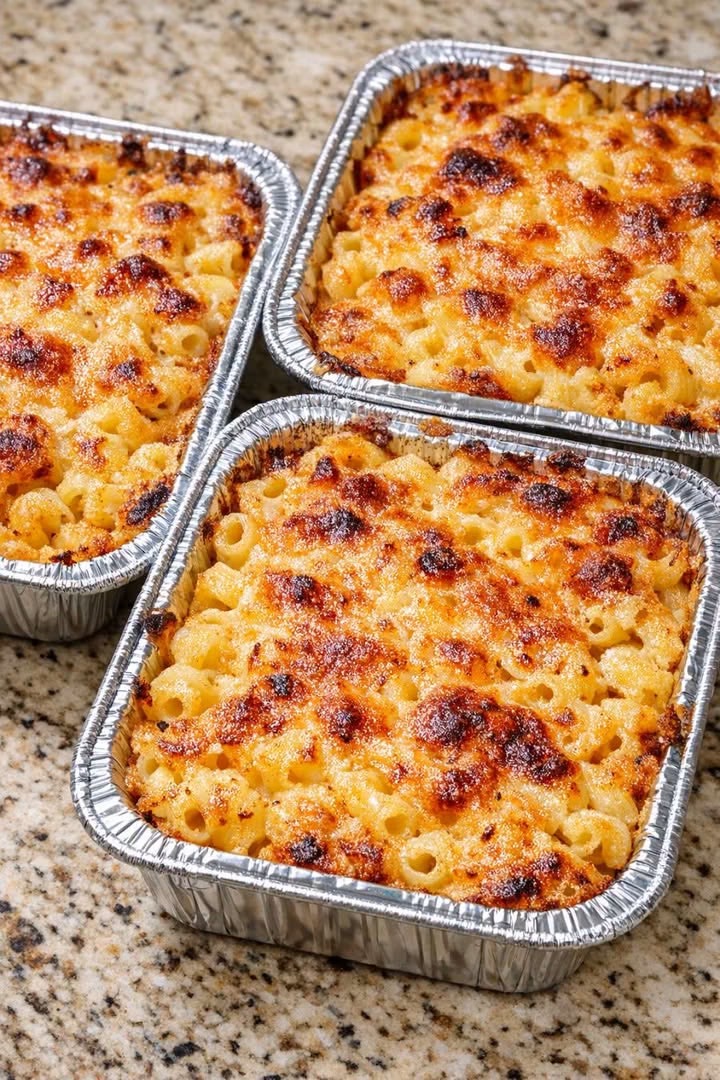
Elbow macaroni in a three-cheese sauce, portioned into individual foil trays and broiled until the tops char in deep golden patches. Built specifically to freeze and reheat, one tray at a time, with no loss of texture.
The technique that decides whether these reheat well is undercooking the pasta before it ever meets the sauce. Pasta cooked to full tenderness continues absorbing liquid in the fridge and freezer, and by the time it is reheated it has gone soft and pasty. Two minutes short of done, it finishes in the oven and holds its bite through freezing and reheating both.
Twenty minutes of prep, twenty-five in the oven, and it makes three trays for the freezer.
Why You Will Love This Recipe
It is built for the freezer, not adapted to it. Every step accounts for what happens between baking and reheating weeks later.
Individual trays mean no cutting a frozen block. Pull one out, thaw or reheat directly, and the rest stay untouched.
The sauce is a proper roux base. Not canned soup, and it holds its texture through freezing far better than one that relies on cream cheese alone.
One batch makes multiple meals. Three trays from one pot, each a full portion.
It reheats with the same texture as fresh. The undercooked pasta and the roux base are both there specifically for this.
Recipe Overview
Prep time: 20 minutes
Cook time: 25 minutes
Total time: 45 minutes
Yield: 3 individual trays, 2 to 3 servings each
Difficulty: Easy
Best for: Freezer meal prep, batch cooking, weeknight dinners
Ingredients
For the pasta
• 1 pound elbow macaroni
• 1 tablespoon salt, for the pasta water
For the cheese sauce
• 4 tablespoons butter
• ¼ cup all-purpose flour
• 3 cups whole milk, warmed
• 1 teaspoon dry mustard powder
• ½ teaspoon garlic powder
• ½ teaspoon salt
• ¼ teaspoon black pepper
• 2 cups sharp cheddar, freshly grated
• 1 cup Gruyère, freshly grated
• 1 cup Monterey Jack, freshly grated
For the topping
• 1 cup panko breadcrumbs
• ½ cup parmesan, freshly grated
• 3 tablespoons butter, melted
Choosing the Right Pasta Shape
Shape affects both sauce cling and how the pasta survives freezing and reheating.
Elbow macaroni. The standard choice and what is shown here. Small enough to portion evenly and its curve holds sauce well.
Cavatappi or cellentani. The ridges and spiral shape hold noticeably more sauce than a smooth elbow. An excellent upgrade if you can find it.
Shells, small or medium. Their cups trap pockets of sauce, which some people prefer to elbows.
Penne. Works, though the larger size means fewer, bigger bites of pasta and less even sauce distribution.
Fresh pasta. Not recommended here. It has too little structure to survive freezing and reheating without turning to mush.
Whatever the shape, choose one with some texture or ridging over something perfectly smooth. Smooth pasta sheds sauce more readily during the freeze-thaw cycle.
Why Undercooking the Pasta and Using a Roux Both Matter for Freezing
Pasta continues absorbing liquid after it comes out of the pot, because starch keeps hydrating as long as there is water nearby, whether that water is in the pasta itself or in the sauce around it. Cooked to full tenderness, then combined with sauce, then chilled or frozen, it keeps pulling in moisture the entire time. What was al dente at assembly is soft and swollen by the time it is reheated weeks later.
Stopping the boil about two minutes early solves this at the source. The pasta still has enough uncooked starch in its centre to firm up rather than dissolve, and it finishes cooking in the oven, in the freezer, and again during reheating, arriving at proper tenderness only at the point of eating rather than well before it.
The sauce needs the same forward planning. A roux-based sauce, where flour is cooked into butter before the milk goes in, forms a starch structure that holds together through a freeze-thaw cycle. A sauce built on cream cheese or a soup can alone has less structural backbone, and it tends to separate into a grainy, oily mess once frozen and reheated. The roux is not just for thickening here. It is what keeps the sauce looking like sauce three weeks later.
How to Make Mac and Cheese for the Freezer
Step 1: Boil the pasta short
Cook the macaroni in well-salted water for 2 minutes less than the package directs. Drain and set aside.
It should still have a firm, slightly underdone bite. That is intentional.
Step 2: Make the roux
Melt the butter in a large saucepan over medium heat, whisk in the flour, and cook for 1 minute, stirring constantly.
Cook it just past raw. You are not browning it, only cooking out the flour taste.
Step 3: Add the milk gradually
Whisk in the warmed milk a little at a time, whisking out any lumps before adding more.
Warm milk prevents the roux from seizing, which cold milk can cause.
Step 4: Simmer until thickened
Cook, whisking often, for 5 to 6 minutes until the sauce coats the back of a spoon. Stir in the mustard powder, garlic powder, salt, and pepper.
Step 5: Melt in the cheese
Remove from the heat and stir in the cheddar, Gruyère, and Monterey Jack in batches, letting each addition melt before adding the next.
Off the heat. Cheese added over direct heat can separate and turn grainy.
Step 6: Combine with the pasta
Fold the drained pasta into the cheese sauce until every piece is coated.
Step 7: Portion into trays
Divide the mixture evenly among three foil trays, spreading it into an even layer in each.
Even layers heat and reheat consistently. A mounded tray cooks unevenly.
Step 8: Top and bake, or freeze first
Mix the panko with the melted butter and parmesan, and scatter it over the tray or trays you are baking now. Bake at 375°F for 20 minutes, then broil for 2 to 3 minutes until deeply golden. For trays going to the freezer, cool completely, add the topping, and freeze without baking.
Baking now cooks the pasta the rest of the way and browns the top. Freezing raw means the whole bake happens later, from frozen.
Step 9: Cool and wrap for the freezer
Cool any freezer-bound trays completely, wrap tightly in a layer of plastic wrap and then foil, and freeze flat.
Wrapping while warm traps steam and causes ice crystals, which is what makes reheated pasta watery.
Tips for the Best Freezer Mac and Cheese
Grate all the cheese from blocks. Pre-shredded cheese is coated in cellulose, which prevents a smooth melt and causes more separation on reheating.
Stop the pasta boil early, without exception. This is the single step that determines whether a reheated tray is tender or mushy.
Add the breadcrumb topping just before baking, not before freezing raw trays. It stays crisper if it goes on right before the tray goes in the oven.
Label trays with the date and oven instructions. A frozen tray with no note is easy to misjudge on timing.
Cool completely before wrapping. Warm pasta trapped in plastic wrap steams itself and turns soggy.
Easy Variations
• Add crumbled cooked bacon to the topping before baking
• Stir in a cup of steamed broccoli florets with the pasta
• Use smoked gouda in place of the Gruyère for a smokier flavour
• Add ¼ teaspoon of cayenne or a dash of hot sauce to the cheese sauce
• Swap the panko topping for crushed buttery crackers
• Add diced ham for a heartier, main-dish version
What to Serve With It
A green salad with a sharp vinaigrette is the natural counterweight to a dish this rich. Roasted broccoli or green beans work well alongside for the same reason.
As a main, it needs little else. A simple protein like grilled chicken or baked sausages turns one tray into a complete dinner for two.
Make-Ahead and Storage
Make ahead. This entire recipe is designed as make-ahead. Assemble, top, and freeze raw for the best texture on reheating.
Fridge. Baked trays keep covered for up to 4 days.
Freezer. Wrapped tightly, raw or baked trays keep for up to 3 months.
Reheating from frozen. Unwrap and bake covered with foil at 350°F for 35 to 40 minutes, then uncover and broil 3 minutes to re-crisp the top. From baked and frozen, add 10 minutes to that time.
Frequently Asked Questions
Can I bake and eat one tray now and freeze the rest raw?
Yes, and that is exactly how this recipe is designed. Top all three, bake what you want tonight, and freeze the rest unbaked.
Why did my frozen mac and cheese turn watery?
Almost always from wrapping it while still warm, or from fully cooking the pasta before freezing rather than undercooking it.
Can I reheat a single portion in the microwave?
Yes, thawed first, though the top will not recrisp. A few minutes under the broiler afterward brings it back.
Do I need three different cheeses?
No, though the combination gives better flavour and meltability than one cheese alone. A double batch of just cheddar works fine.
Can I use gluten-free pasta?
Yes. Undercook it slightly more than the two minutes suggested here, since gluten-free pasta softens faster on reheating.
How long does a tray take to thaw before baking?
Overnight in the fridge cuts the reheating time roughly in half. It can also go straight from freezer to oven if you have the extra time.
Nutrition Information
• Calories: 520 per serving, based on 8 total servings
• Protein: 24g
• Fat: 30g
• Carbohydrates: 38g
• Fiber: 1g
• Sodium: 680mg
Nutrition is estimated and will vary with portion size and brands used.