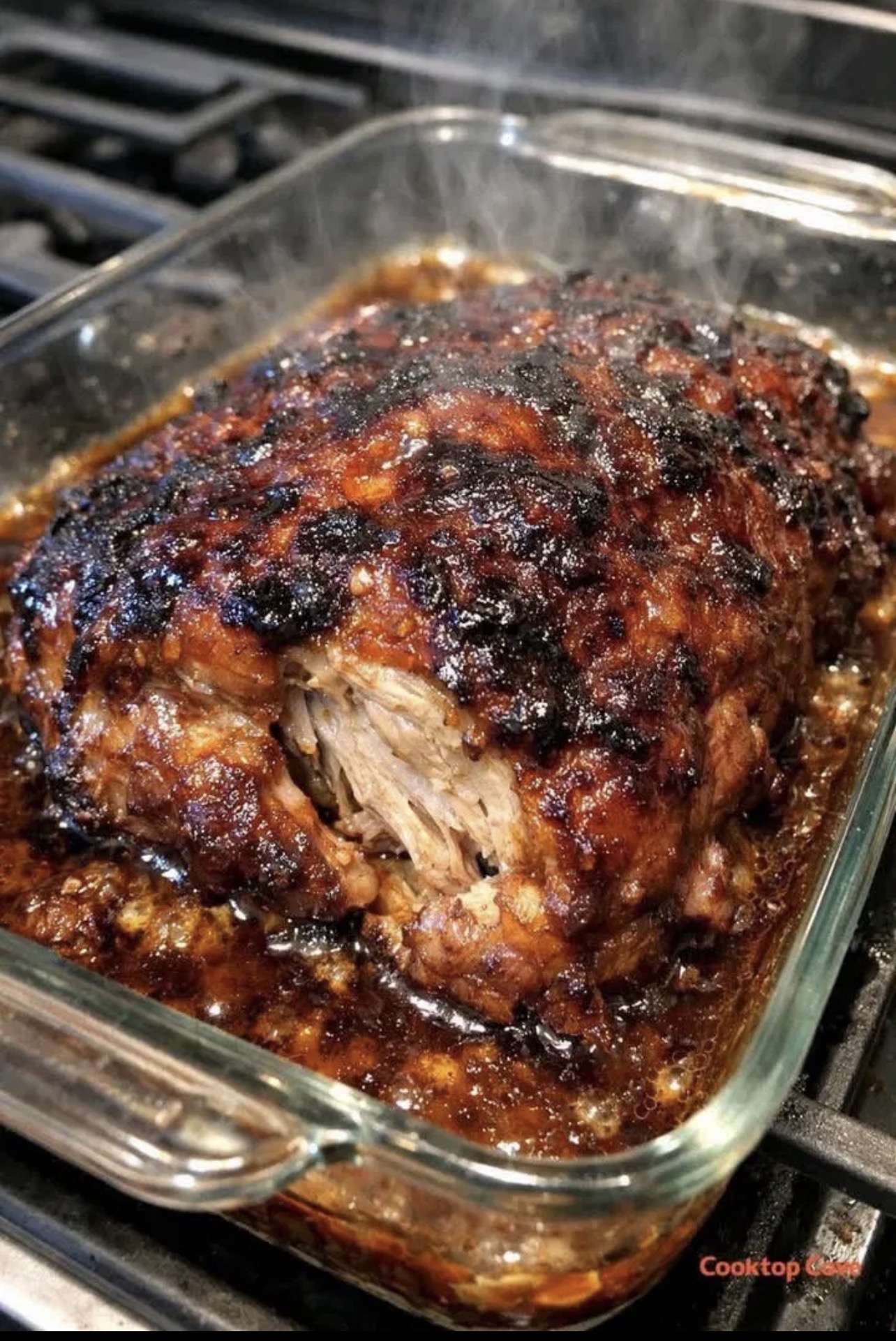
This is a pork shoulder roasted low for hours until the connective tissue melts, then glazed and blasted at high heat at the end for the dark crackling crust in the photo. It pulls apart with a fork and needs no knife.
The two temperatures are what make it work. Low heat does the tenderising, and the last twenty minutes at high heat does the browning. Trying to do both at one temperature gives you either a pale roast or a burnt one.
It needs six hours in the oven and about fifteen minutes of your attention.
Why You Will Love This Recipe
It is nearly impossible to overcook. Pork shoulder has so much collagen and fat that an extra hour improves it rather than ruining it.
The cheapest cut, the best result. Pork shoulder costs a fraction of a loin and tastes considerably better cooked this way.
Fifteen minutes of hands-on work. Season, roast, glaze, rest.
It feeds twelve from one piece. And the leftovers are arguably better than the first meal.
The pan juices become the sauce. Skimmed and reduced, they need nothing added.
Recipe Overview
Prep time: 15 minutes
Roast time: 5 1/2 to 6 1/2 hours
Rest time: 30 minutes
Total time: About 7 hours
Yield: 10 to 12 servings
Difficulty: Easy
Best for: Sunday dinner, holidays, feeding a crowd, meal prep, sandwiches
Ingredients
For the Pork
• 6 to 8 pound bone-in pork shoulder, also sold as pork butt or Boston butt
• 2 tablespoons kosher salt
• 1 tablespoon coarsely ground black pepper
• 1 tablespoon smoked paprika
• 2 teaspoons garlic powder
• 2 teaspoons onion powder
• 1 teaspoon dried oregano
• 2 tablespoons olive oil
For the Pan
• 1 large yellow onion, cut into thick wedges
• 6 cloves garlic, peeled
• 1 1/2 cups (360 ml) chicken broth or apple cider
For the Glaze
• 1/2 cup (110 g) packed dark brown sugar
• 1/4 cup (60 ml) apple cider vinegar
• 3 tablespoons Dijon mustard
• 2 tablespoons Worcestershire sauce
• 1 tablespoon soy sauce
• 1/2 teaspoon black pepper
Choosing the Right Cut
Pork shoulder is the correct cut and the names are confusing. It is sold as pork butt, Boston butt, or picnic shoulder, and all come from the front leg and shoulder area despite what “butt” suggests.
Bone-in is better than boneless. The bone conducts heat into the centre and adds flavour to the juices, and it slides out cleanly when the meat is done.
Pork butt is the upper section and the best choice. It is more marbled and more evenly shaped than the picnic cut.
Picnic shoulder works and is cheaper. It has more skin and connective tissue, so it takes slightly longer.
Do not use pork loin. It is lean and will be dry and stringy after six hours. This recipe depends entirely on fat and collagen.
Leave the fat cap on. Score it in a diamond pattern about half an inch deep. It bastes the roast for hours and renders into the pan.
Why It Cooks to 200°F, Not 145°F
Pork shoulder is the one pork cut where the safe temperature is not the target temperature.
145°F is the safety threshold for whole pork. A loin is perfect there. A shoulder at 145°F is safe and completely inedible, because the collagen has not yet broken down.
Collagen converts to gelatin between about 180 and 205°F. That conversion is what makes the meat pull apart and what gives the juices their glossy body. It takes hours at those temperatures, not minutes.
Aim for 200 to 205°F internal. At that point a fork twists freely and the bone lifts out with no resistance.
The stall is normal. Around 160°F the temperature can sit still for an hour or more as moisture evaporates from the surface. Do not raise the oven temperature to push through it.
Test by feel as well as temperature. A probe should slide in like the meat is soft butter.
How to Make Slow Roasted Pork Shoulder
Step 1: Bring it to room temperature
Take the pork out of the refrigerator 1 hour before cooking. A cold centre adds a full hour to the cook time.
Step 2: Season heavily
Preheat the oven to 300°F (150°C).
Pat the pork completely dry. Rub it all over with olive oil, then with the salt, pepper, smoked paprika, garlic powder, onion powder, and oregano.
Season more heavily than feels right. This is a large piece of meat and most of the seasoning only reaches the surface.
Step 3: Set up the pan
Scatter the onion wedges and garlic cloves in a deep roasting dish and pour in the broth or cider.
Place the pork on top, fat side up, so it sits above the liquid rather than in it.
Step 4: Roast covered
Cover the dish tightly with foil and roast for 4 hours.
The foil traps steam and speeds the collagen breakdown. This stage is about tenderness, not colour.
Step 5: Uncover and continue
Remove the foil and roast for another 1 1/2 to 2 hours, until the internal temperature reaches 195°F.
Baste with the pan juices every 30 minutes during this stage.
Step 6: Make the glaze
Whisk together the brown sugar, vinegar, Dijon, Worcestershire, soy sauce, and black pepper in a small saucepan and simmer for 5 minutes until syrupy.
Step 7: Glaze and blast
Raise the oven to 450°F (230°C).
Brush the pork generously with the glaze and roast for 15 to 20 minutes, brushing once more halfway, until the surface is dark and caramelized.
Watch it closely. The sugar in the glaze goes from dark to burnt in a few minutes at this temperature.
Step 8: Check the final temperature
The pork is ready at 200 to 205°F, when a fork twists easily and the bone wiggles freely.
Step 9: Rest, then pull
Tent loosely with foil and rest for 30 minutes.
A roast this large holds a great deal of juice, and thirty minutes is the minimum for it to redistribute.
Pull the meat apart with two forks, discarding large pockets of fat and the bone. Skim the pan juices and spoon them over.
Tips for the Best Pork Shoulder
Cook to temperature, never to time. A 7 pound shoulder can take anywhere from five to seven hours depending on shape and starting temperature.
Score the fat cap. It renders far more evenly and the glaze grips the cuts.
Glaze only at the end. Twenty minutes at high heat, not six hours at low.
Do not skip the rest. Thirty minutes minimum for a roast this size.
Skim the pan juices before serving. There will be a substantial fat layer. Underneath it is the best sauce in the dish.
Common Mistakes to Avoid
Using pork loin. The most consequential error. It has no collagen to break down.
Pulling it at 145°F. Safe but tough. This cut needs 200°F.
Panicking at the stall. The temperature plateau around 160°F is normal and lasts up to two hours.
Glazing from the start. Six hours of sugar at any temperature produces a black bitter crust.
Slicing instead of pulling. At 200°F the meat will not hold slices. It is meant to be pulled.
Easy Variations
• Carolina style. Skip the glaze and serve with a thin vinegar and pepper sauce.
• Cuban style. Marinate overnight in orange juice, lime, garlic, and oregano.
• Smoky barbecue. Add 1 teaspoon of liquid smoke to the pan liquid and use barbecue sauce in place of the glaze.
• Beer braised. Replace the broth with a bottle of lager.
• Slow cooker. Cook on low for 9 to 10 hours, then glaze and finish under the broiler for 10 minutes.
• Spicy. Add 1 tablespoon of chipotle powder to the rub and cayenne to the glaze.
What to Serve With It
Coleslaw is the standard partner, and its acidity is genuinely necessary against this much rich pork.
Soft rolls turn it into pulled pork sandwiches, which is what most of the leftovers become anyway.
Baked beans, cornbread, potato salad, and pickles complete a barbecue plate.
For a Sunday dinner, mashed potatoes, roasted vegetables, and the skimmed pan juices work just as well.
Make-Ahead and Storage
Make-ahead: Season the pork and refrigerate uncovered for up to 24 hours. This dries the surface and improves the crust considerably. The glaze keeps for a week.
Refrigerator: Store pulled pork in its juices for up to 4 days. Keeping it submerged is what prevents it drying out.
Freezer: Freeze pulled pork with some of its juices for up to 3 months.
To reheat: Warm covered at 300°F with a splash of broth for 20 minutes, or gently in a covered pan. High heat dries it out quickly once pulled.
Frequently Asked Questions
What is the difference between pork butt and pork shoulder?
Pork butt is the upper part of the shoulder and picnic shoulder is the lower part. Both work here, and pork butt is slightly better marbled.
Why did the temperature stop rising?
That is the stall, caused by evaporative cooling at the surface. It is normal, can last two hours, and passes on its own.
Can I use a boneless shoulder?
Yes. Reduce the cooking time by about 45 minutes and check earlier.
Can I cook it overnight?
Yes. At 250°F it takes about 9 hours, which suits an overnight cook well. Glaze and blast in the morning.
Is 200°F really safe?
Well past safe. 145°F is the safety minimum for pork, and 200°F is about texture rather than safety.
How much per person?
Plan on about half a pound of raw weight per person. A 7 pound shoulder feeds twelve comfortably with leftovers.
Nutrition Information
Approximate values per serving, based on 12 servings:
• Calories: 465
• Total fat: 31 g
• Saturated fat: 11 g
• Carbohydrates: 11 g
• Sugar: 9 g
• Protein: 36 g
• Sodium: 890 mg
Nutrition is estimated and will vary with trimming and portion sizes.
Final Thoughts
Slow roasted pork shoulder asks for patience rather than skill. Season it heavily, cover it for four hours, uncover it for two more, and only then think about the glaze.
Cook to 200°F rather than to the clock, ignore the stall, and give it a full thirty minutes to rest before you pull it apart.