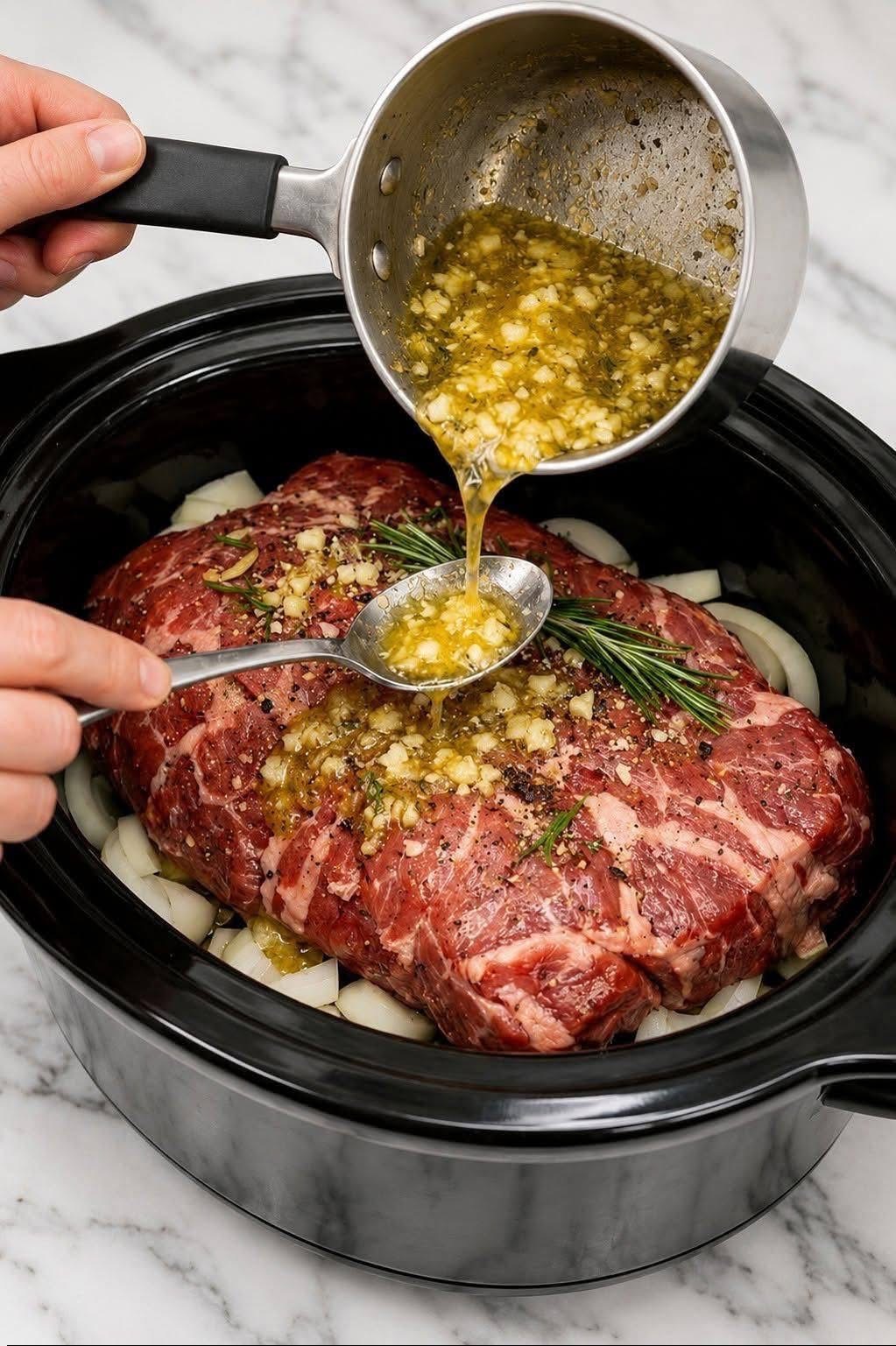
This Slow Cooker Garlic Butter Pot Roast cooks low and slow over a bed of onions until the beef pulls apart under a fork. A pan of melted garlic butter poured over the top before the lid goes on seasons the meat from the outside in and builds the base of the gravy underneath.
It is the kind of dinner that asks for twenty minutes of work in the morning and then takes care of itself. By evening the house smells like a restaurant and there is a pot of beef, onions, and rich brown juices waiting.
Chuck roast is the cut that makes it work. It has enough fat and connective tissue to survive eight hours of gentle heat and turn silky instead of dry.
Why You Will Love This Recipe
Twenty minutes of hands-on work. Sear, stack, pour, and walk away. The slow cooker handles the other eight hours.
The garlic butter does double duty. It seasons the roast as it melts down and then enriches the drippings that become the gravy.
It feeds a crowd cheaply. Chuck roast is one of the least expensive beef cuts and one of the most flavorful when cooked this way.
Leftovers are almost better. The meat reheats beautifully and turns into sandwiches, tacos, and pasta later in the week.
It is forgiving. An extra hour will not ruin it. This is not a recipe that punishes you for being late.
Recipe Overview
Prep time: 20 minutes Cook time: 8 to 9 hours on low, or 4 to 5 hours on high Total time: About 8 hours 20 minutes Yield: 6 servings Difficulty: Easy Best for: Sunday dinner, meal prep, cold weather, feeding a family, holiday tables
Ingredients
For the Roast
3 to 4 pound boneless beef chuck roast 2 teaspoons kosher salt 1 teaspoon coarsely ground black pepper 2 tablespoons olive oil 2 large yellow onions, cut into thick wedges 1 cup (240 ml) beef broth 1 tablespoon Worcestershire sauce 3 sprigs fresh rosemary
For the Garlic Butter
4 tablespoons unsalted butter 8 to 10 cloves garlic, finely minced 1 teaspoon dried Italian seasoning 1/2 teaspoon coarsely ground black pepper
For the Gravy, Optional
2 tablespoons cornstarch 2 tablespoons cold water
Choosing the Right Cut of Beef
Chuck roast is the correct choice and it is not close. It comes from the shoulder, which is full of collagen and marbling. Over long, low heat that collagen melts into gelatin and gives the meat its glossy, fall-apart texture.
Brisket flat works as a substitute but is leaner and slices better than it shreds. Add an extra half cup of broth if you use it.
Bottom round and rump roast can be used, but they will be noticeably drier. These are lean cuts, and no amount of slow cooking adds fat that was never there.
Avoid tenderloin, sirloin, and any premium steak cut. They have nothing to break down and will turn stringy and grey in a slow cooker.
Look for visible marbling. Thin white veins running through the meat are exactly what you want. A roast that looks uniformly red and lean will disappoint you eight hours later.
Do You Really Need to Sear It?
Searing is optional in the sense that the roast will cook without it. It is not optional if you want the dish to taste like it should.
Browning the surface of the meat creates hundreds of new flavor compounds that no amount of simmering will produce on its own. A slow cooker cannot brown anything, because the environment inside stays wet and below boiling.
The difference is easy to taste side by side. Seared roast has depth and a savory, roasted edge. Unseared roast tastes flatter and slightly steamed.
It costs about six minutes. If you truly do not have them, skip it and add an extra teaspoon of Worcestershire sauce to compensate slightly.
How to Make Slow Cooker Garlic Butter Pot Roast
Step 1: Season the roast
Pat the chuck roast completely dry with paper towels. This matters more than it sounds, because a wet surface will steam rather than brown.
Season all sides generously with the kosher salt and black pepper, pressing it into the meat.
Step 2: Sear on all sides
Heat the olive oil in a large skillet over medium-high heat until it shimmers. Add the roast and sear for 3 to 4 minutes per side, including the ends, until a deep brown crust forms.
Do not move the meat while each side is browning. Let it sit and build color.
Step 3: Build the base
Scatter the onion wedges across the bottom of the slow cooker in an even layer. They act as a rack, keeping the roast off the hot base, and they collapse into the gravy by the end.
Set the seared roast directly on top of the onions.
Step 4: Make the garlic butter
Melt the butter in a small saucepan over low heat. Add the minced garlic, Italian seasoning, and black pepper and cook for 60 to 90 seconds, just until fragrant.
Do not let the garlic brown. Slow-cooked burnt garlic turns bitter over eight hours, and there is no fixing it later.
Step 5: Pour it over the roast
Spoon the garlic butter evenly over the top of the roast, letting it run down the sides. Scrape every bit of garlic out of the pan.
Tuck the rosemary sprigs alongside the meat, then pour the beef broth and Worcestershire sauce around the base of the roast rather than over the top, so you do not rinse off the butter.
Step 6: Cook low and slow
Cover and cook on low for 8 to 9 hours, or on high for 4 to 5 hours. Low is significantly better here. The slower the collagen breaks down, the more tender the result.
Resist lifting the lid. Every peek releases steam and adds roughly twenty minutes to the cook time.
Step 7: Check for doneness
The roast is ready when a fork twists easily in the meat and it separates without resistance. If it still feels tight, it needs more time, not less.
Pot roast does not follow the usual temperature rules. It is properly done around 200 to 205°F, well past the point where a steak would be ruined.
Step 8: Make the gravy
Transfer the roast to a board and tent it with foil. Strain the cooking liquid into a saucepan and skim off the excess fat from the surface.
Whisk the cornstarch and cold water together, then whisk the slurry into the simmering liquid. Cook for 2 to 3 minutes until thickened. Taste and add salt as needed.
Step 9: Shred and serve
Pull the beef apart with two forks, discarding any large pockets of fat and the rosemary stems. Return the meat to the onions, spoon some gravy over the top, and serve the rest alongside.
Tips for the Best Pot Roast
Do not add water. The roast and onions release a surprising amount of liquid. One cup of broth is enough, and more will dilute the flavor into something closer to soup.
Cook on low whenever you can. High heat gets you there faster but produces noticeably tougher, more shredded-looking meat.
Salt the meat, not the broth. Beef broth is often already salty, and the gravy concentrates as it reduces. Season the gravy at the end, once you can taste it.
Leave the fat cap on. Trim any thick hard pieces, but the fat that runs through the roast is doing important work. Skim the finished liquid instead.
Add vegetables late if you want them intact. Potatoes and carrots added at the start will be soft. Add them during the last 3 hours on low for pieces that hold their shape.
Easy Variations
With potatoes and carrots. Add 1.5 pounds of halved baby potatoes and 4 thick-cut carrots during the final 3 hours of cooking.
Red wine pot roast. Replace half the broth with dry red wine. Simmer the wine in the searing skillet first to cook off the alcohol, scraping up the browned bits, then pour it in.
Mushroom and thyme. Add 8 ounces of quartered cremini mushrooms in the last 2 hours and swap the rosemary for fresh thyme.
Balsamic garlic. Add 2 tablespoons of balsamic vinegar with the broth for a sweeter, tangier gravy.
Spicy. Add 1 teaspoon of smoked paprika and 1/2 teaspoon of cayenne to the garlic butter.
Dutch oven version. Sear in the pot, add everything, cover, and braise at 300°F for 3.5 to 4 hours.
What to Serve With It
Mashed potatoes are the classic partner, mostly because they are a vehicle for the gravy. Creamy polenta and buttered egg noodles do the same job.
Crusty bread or dinner rolls are close to mandatory. There will be gravy left, and nobody wants to leave it.
For something green, roasted green beans, garlic broccoli, buttered peas, or a sharp vinegary salad all cut through the richness well.
For leftovers, pile the shredded beef onto toasted rolls with provolone, fold it into tacos with pickled onions, or stir it through pasta with a little of the gravy.
Make-Ahead and Storage
Make-ahead: Sear the roast and prepare the garlic butter the night before. Refrigerate both separately and assemble in the morning. Do not leave the slow cooker insert loaded in the refrigerator overnight and then start it cold, since it takes too long to reach a safe temperature.
Refrigerator: Store the meat in its juices in an airtight container for up to 4 days. Keeping it submerged is what stops it drying out.
Freezer: Freeze the shredded beef with some of its liquid for up to 3 months. Thaw overnight in the refrigerator.
To reheat: Warm gently in a covered pan over low heat with a splash of broth or gravy, or in a 325°F oven for 20 minutes. High heat squeezes the moisture back out of the meat.
Frequently Asked Questions
Why is my pot roast tough? It is almost always undercooked, not overcooked. Tough pot roast needs another hour or two for the connective tissue to finish breaking down.
Can I put the roast in frozen? No. A frozen roast spends too long in the temperature range where bacteria multiply. Thaw it fully in the refrigerator first.
Do I have to use a slow cooker? No. A Dutch oven at 300°F for 3.5 to 4 hours or a pressure cooker for 60 to 70 minutes on high with a natural release both work.
Can I use garlic powder instead of fresh garlic? You can, but fresh garlic melting into butter is most of the appeal here. If you must, use 1 tablespoon of garlic powder.
How much roast do I need per person? Plan on about half a pound of raw chuck roast per person. A 3 pound roast comfortably feeds six.
Can I cook two roasts at once? Yes, if they fit in a single layer without stacking. Add about an hour to the cook time and check for tenderness rather than watching the clock.
Nutrition Information
Approximate values per serving, based on 6 servings and not including gravy thickener:
Calories: 520 Total fat: 35 g Saturated fat: 15 g Carbohydrates: 7 g Fiber: 1 g Protein: 44 g Sodium: 690 mg
Nutrition is estimated and will vary with the cut, trimming, and brands used.
Final Thoughts
Slow Cooker Garlic Butter Pot Roast is proof that the cheapest cut in the case can produce the best meal of the week. Sear it properly, pour the garlic butter over the top, and let time do the rest.
Make it once on a Sunday and you will understand why it stays in the rotation all winter.