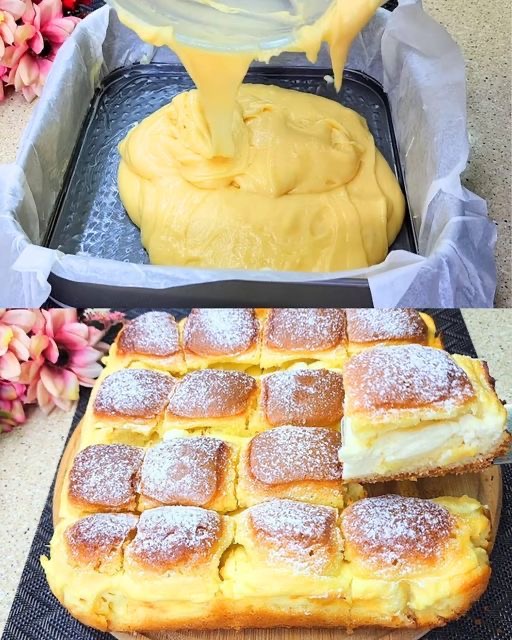
Lemon Custard Pillow Cake
Lemon adds a bright flavor that balances the rich vanilla custard.
Add one tablespoon of finely grated lemon zest to the cake batter.
Replace one teaspoon of vanilla in the custard with fresh lemon zest.
You may also add one tablespoon of lemon juice after the custard is removed from the heat.
Avoid adding too much lemon juice while cooking because strong acidity can affect the milk’s texture.
Dust the finished cake with powdered sugar and additional lemon zest.
Chocolate Custard Cake
For a chocolate variation, add ¼ cup of unsweetened cocoa powder to the cake batter.
Reduce the flour by ¼ cup.
Add four ounces of melted semi-sweet chocolate to the custard after cooking.
Whisk until smooth.
Chocolate cake with vanilla or chocolate custard creates a rich dessert suitable for birthdays and holiday gatherings.
Decorate with chocolate curls or a light ganache drizzle.
Strawberry Custard Cake
Fresh strawberries can be added shortly before serving.
Do not place a large amount of fresh fruit inside the batter because the strawberries may release excess water.
Instead, spoon sliced strawberries over each cooled cake square.
You can also spread a thin layer of strawberry preserves over the cake before dusting it with powdered sugar.
For a softer fruit filling, swirl small spoonfuls of thick strawberry preserves between the custard lines before baking.
Blueberry Vanilla Cake
Scatter approximately one cup of fresh blueberries lightly over the batter before piping the custard.
Use dry berries.
Toss them with one tablespoon of flour to reduce sinking.
Frozen blueberries may release more liquid and create purple streaks.
When using frozen berries, add them directly from the freezer without thawing.
The finished cake pairs beautifully with lemon zest and powdered sugar.
Coconut Custard Cake
Replace half of the whole milk in the custard with canned coconut milk.
Add ½ teaspoon coconut extract.
Sprinkle toasted shredded coconut over the cooled cake.
To toast coconut, place it inside a dry skillet over medium-low heat.
Stir constantly until lightly golden.
Transfer it immediately to a cool plate.
Coconut custard cake works especially well for spring and summer gatherings.
Caramel Custard Cake
Drizzle room-temperature caramel sauce over each square before serving.
A small amount of flaky sea salt can create a salted-caramel version.
Avoid pouring hot caramel over the cake because it may melt the powdered sugar and soften the custard surface.
Chopped toasted pecans or walnuts add extra texture.
Cinnamon Custard Cake
Add one teaspoon of ground cinnamon to the cake batter.
Mix two tablespoons of sugar with ½ teaspoon of cinnamon.
Sprinkle the mixture lightly over the top before baking.
After cooling, add powdered sugar.
This variation pairs well with coffee, black tea, and warm apple compote.
Almond Vanilla Cake
Replace ½ teaspoon of vanilla extract with almond extract.
Almond extract has a strong flavor, so measure it carefully.
Sprinkle sliced almonds over the cake during the final 10 minutes of baking.
Serve with powdered sugar and fresh berries.
Can You Use Instant Pudding?
Instant pudding can be used as a shortcut, but homemade custard provides a smoother and richer texture.
Prepare one package of instant vanilla pudding using slightly less milk than listed on the package.
The pudding should be thick enough to pipe.
Refrigerate it briefly before adding it to the batter.
Do not use overly thin pudding because it may disappear into the cake during baking.
Can You Use Cook-and-Serve Pudding?
Yes.
Prepare the pudding according to the package directions.
Cook until thick.
Allow it to cool while covered directly with plastic wrap.
Use it in place of the homemade custard.
Make sure the pudding is cool but still soft enough to pipe.
Can You Make the Cake Without Cream Cheese?
Yes.
Leave the cream cheese out of the custard.
Increase the cornstarch by approximately one tablespoon if the filling feels too thin.
The custard will be lighter and closer to traditional pastry cream.
Cream cheese creates a richer and slightly tangier filling but is not essential.
Gluten-Free Custard Cake
Use a high-quality one-to-one gluten-free baking flour that includes xanthan gum.
Replace the all-purpose flour in equal quantities.
Make sure the cornstarch, baking powder, vanilla extract, and powdered sugar are certified gluten-free when necessary.
Gluten-free cake may be slightly more delicate.
Allow it to cool completely before lifting or cutting.
How to Serve Vanilla Custard Cake
Serve the cake at room temperature, slightly warm, or chilled.
Each option creates a different texture.
Warm cake has very soft custard.
Room-temperature cake is tender and creamy.
Chilled cake is firmer and easier to cut neatly.
Serve each square with:
Fresh berries
Whipped cream
Vanilla ice cream
Caramel sauce
Fruit compote
Powdered sugar
Toasted nuts
Hot coffee
Iced coffee
Black tea
Because the cake contains a rich custard, moderately sized pieces are usually sufficient.
Serving the Cake for Breakfast or Brunch
The vanilla flavor and soft texture make this cake suitable for a special breakfast or brunch table.
Cut it into smaller squares.
Serve with fresh fruit, coffee, tea, or milk.
Add powdered sugar shortly before placing it on the table.
Keep the cake refrigerated until approximately 20 minutes before serving.
Serving the Cake at a Party
Cut the chilled cake into small squares.
Place each piece inside a paper cupcake liner.
This makes the dessert easier for guests to pick up.
Keep the tray refrigerated until shortly before serving.
For an outdoor gathering, place the serving tray over a larger container filled with ice.
Do not leave custard cake in direct sunlight or warm conditions for an extended period.
Make-Ahead Instructions
The custard can be prepared one day in advance.
Press plastic wrap directly against its surface.
Store it in the refrigerator.
Before using, whisk until smooth.
The complete cake can also be baked one day before serving.
Cool it completely.
Cover and refrigerate overnight.
Add powdered sugar shortly before serving.
The flavor often improves after several hours because the vanilla custard and cake have time to settle together.
How to Store the Cake
Because the dessert contains milk, eggs, cream cheese, and custard, store it in the refrigerator.
Place the cake inside an airtight container or cover the baking pan tightly.
Refrigerate for up to four days.
Place parchment paper between layers when stacking individual pieces.
Do not leave the cake at room temperature for longer than two hours.
During hot weather, refrigerate it sooner.
Can You Freeze Custard Cake?
Freezing is possible, although the custard texture may become slightly softer after thawing.
Cool and chill the cake completely.
Cut it into individual squares.
Wrap every piece tightly with plastic wrap.
Place the wrapped pieces inside a freezer-safe container.
Freeze for up to one month.
Thaw overnight in the refrigerator.
Add fresh powdered sugar after thawing.
Freezing without fruit or whipped toppings gives the best result.
How to Reheat the Cake
The cake can be served cold, so reheating is optional.
To warm one square, place it inside a microwave-safe dish.
Heat for approximately 10–15 seconds.
Do not overheat it because the custard may become runny.
For several portions, place them inside a covered baking dish and warm at 300°F for approximately eight minutes.
Dust with fresh powdered sugar after heating.
Common Mistakes to Avoid
Using Cold Cream Cheese
Cold cream cheese creates lumps inside the custard.
Allow it to soften fully before combining it with the cooked mixture.
Making the Custard Too Thin
The custard must be thick enough to sit on the cake batter.
Cook until it coats the spoon and holds a clear line.
Thin custard may blend into the batter instead of creating visible pockets.
Adding Hot Custard to the Batter
Very hot custard can begin melting or cooking the cake batter before it reaches the oven.
Allow it to cool for at least 20 minutes.
Overmixing the Cake Batter
Too much mixing develops gluten and can make the cake dense.
Mix only until the flour disappears.
Adding Too Much Flour
Measure flour by spooning it lightly into the measuring cup and leveling the top.
Do not scoop directly from a tightly packed container.
Overbaking the Cake
The custard should remain soft.
Test only the cake sections with a toothpick.
Remove the pan when the cake is golden and fully set.
Cutting the Cake Too Soon
Warm custard is delicate.
Allow the cake to cool and preferably chill before cutting clean squares.
Why Did My Custard Sink Completely?
The custard may have been too thin or too warm.
The cake batter may also have been unusually loose.
Cook the custard until thick and cool it before piping.
The batter should be thick enough to support the filling.
Why Is My Cake Dense?
The butter and sugar may not have been creamed long enough.
The batter may also have been overmixed after adding flour.
Use fresh baking powder and baking soda.
Measure every ingredient carefully.
Why Did the Cake Sink in the Center?
The oven door may have been opened too early.
The center may also have been underbaked.
Bake until the cake around the custard feels set and springs back lightly.
Allow the cake to cool gradually.
Why Is the Custard Lumpy?
The egg mixture may not have been tempered slowly.
The saucepan may also have been too hot.
Whisk constantly and cook over medium-low heat.
Strain the finished custard to remove any small lumps.
Why Did the Bottom Become Soggy?
The custard may have been too thin or added in excessive quantities.
Make sure the custard is thick.
Use only enough to create a visible grid or separate pockets.
Bake until the cake sections are fully cooked.
Frequently Asked Questions
Can I Use Vanilla Bean Paste?
Yes.
Replace vanilla extract with an equal amount of vanilla bean paste.
The custard will contain small vanilla specks and have a deeper flavor.
Can I Make the Cake in a Smaller Pan?
Yes.
A smaller pan creates a thicker cake.
Use an 8- or 9-inch square pan for approximately half the recipe.
Begin checking the center after 30–35 minutes.
Can I Double the Recipe?
Yes.
Prepare the cake inside two separate 9-by-13-inch pans.
Do not bake a double quantity inside one deep pan because the center may cook unevenly.
Can I Use Low-Fat Cream Cheese?
Yes, but the custard may be slightly softer.
Full-fat block cream cheese provides the richest and most stable filling.
Avoid whipped cream cheese sold in tubs.
Can I Use Buttermilk?
Yes.
Buttermilk creates a tender crumb with a mild tang.
Use it in equal quantities as a substitute for whole milk in the cake batter.
Can I Leave Out the Sour Cream?
Yes.
Replace it with plain Greek yogurt or additional milk.
The cake may be slightly less rich when using only milk.
Can I Add Fruit Inside the Custard?
Small pieces of dry fruit can be added, but watery fruit may thin the filling.
Fruit sauces and fresh berries are usually more reliable when served on top.
How Do I Know the Custard Is Thick Enough?
The custard should coat the back of a spoon.
A line drawn through it should remain visible.
It should fall slowly from the whisk rather than pouring like milk.
Final Note
Fluffy Vanilla Custard Pillow Cake is a beautiful dessert made with tender vanilla sponge and smooth custard pockets.
The piped custard creates a soft pillow-like pattern as the cake rises and turns golden in the oven.
Prepare the custard until thick, keep the cake batter light, and avoid overbaking.
Allow the cake to cool before cutting, then finish it with a generous dusting of powdered sugar.
Serve it for holidays, birthdays, brunch, potlucks, family dinners, or afternoon coffee.
The combination of soft cake, creamy vanilla filling, golden edges, and powdered sugar makes every square simple, elegant, and satisfying.