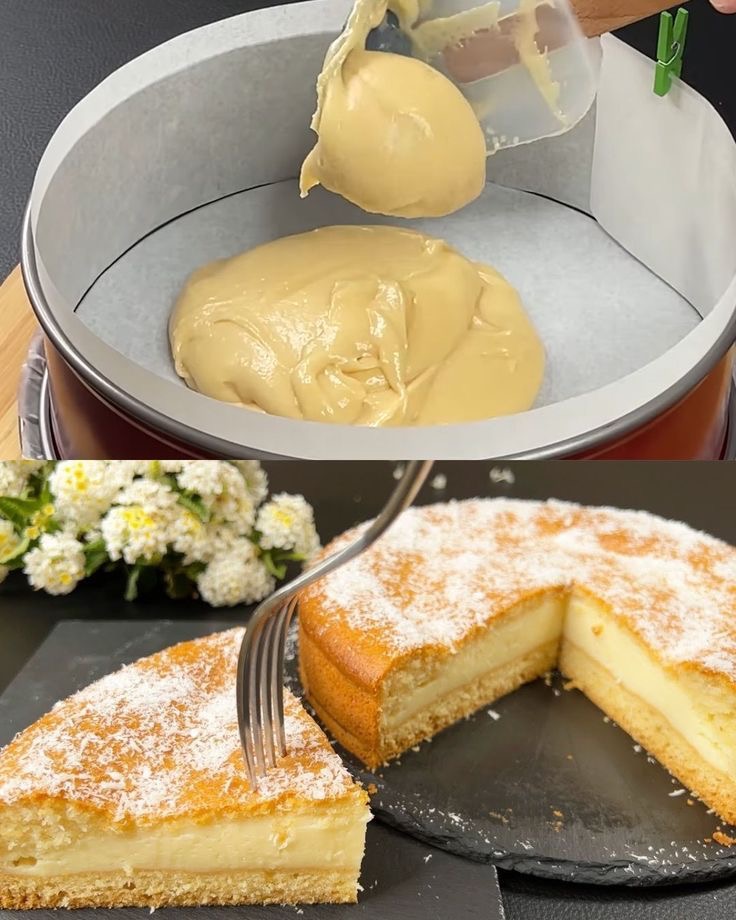
This Creamy Vanilla Custard Layer Cake combines a soft golden sponge with a thick, silky vanilla filling in the center.
The cake batter rises around the custard while baking, creating two tender cake layers separated by a smooth and creamy middle. A light dusting of powdered sugar gives the finished dessert a simple bakery-style appearance.
This homemade vanilla cake is perfect for family dinners, birthdays, holidays, afternoon coffee, potlucks, bridal showers, or any occasion that needs an elegant dessert made from familiar ingredients.
The cake tastes delicious at room temperature, but chilling it produces a firmer custard layer and cleaner slices. Every piece delivers soft cake, rich vanilla cream, and a delicate sweetness without requiring complicated decoration.
Why This Recipe Is Popular
Vanilla custard cake is popular because it combines the comfort of homemade sponge cake with the luxurious texture of pastry cream.
The cake looks impressive when sliced, but the preparation is easier than building and frosting a traditional layer cake.
The custard is cooked on the stovetop before being added to the pan. This helps it remain thick and creamy while the surrounding cake batter bakes.
The recipe is also easy to prepare ahead. Once chilled, the cake holds its shape well and can be sliced shortly before serving.
Its mild vanilla flavor makes it suitable for children and adults, while fruit, chocolate, caramel, or coconut can be added when you want a different variation.
Recipe Information
The preparation time is approximately thirty minutes.
The custard requires about ten minutes of cooking and twenty minutes of cooling.
The cake bakes for approximately forty to fifty minutes.
Allow at least one hour for cooling and two hours for chilling.
The recipe provides approximately twelve servings.
Main Ingredients
All-purpose flour gives the cake enough structure to hold the creamy filling while keeping the crumb soft.
Butter adds richness and creates a tender texture.
Eggs help the cake rise and provide stability.
Whole milk keeps both the sponge and custard smooth and moist.
Cornstarch thickens the vanilla filling without making it heavy.
Vanilla extract provides the main flavor of the dessert.
Sour cream or Greek yogurt adds extra moisture and helps prevent the cake from becoming dry.
Ingredients for the Vanilla Custard
For the custard, you will need two cups of whole milk, half a cup of granulated sugar, four large egg yolks, one-quarter cup of cornstarch, two teaspoons of pure vanilla extract, two tablespoons of unsalted butter, and a small pinch of salt.
For an especially rich filling, you may also add four ounces of softened cream cheese or one-quarter cup of heavy cream.
The cream cheese is optional, but it gives the custard a thicker and slightly tangier texture.
Ingredients for the Cake Batter
For the cake, you will need two and a half cups of all-purpose flour, two teaspoons of baking powder, half a teaspoon of baking soda, half a teaspoon of salt, three-quarters of a cup of softened unsalted butter, one and one-quarter cups of granulated sugar, four large eggs at room temperature, two teaspoons of vanilla extract, one cup of whole milk, and one-quarter cup of sour cream or plain Greek yogurt.
You will also need powdered sugar for decorating the cooled cake.
The Best Pan to Use
A nine-inch springform pan works especially well for this cake.
The removable sides make it easier to release the dessert without damaging the soft custard center.
A deep nine-inch round cake pan may also be used, but it should be lined carefully with parchment paper.
Line the bottom of the pan with a parchment circle.
Create a tall parchment collar around the inside edge because the cake may rise significantly while baking.
Lightly grease the pan before adding the parchment so the paper remains in place.
Place the prepared pan on a baking sheet to make it easier to move and to catch any small drips.
Why Room-Temperature Ingredients Matter
Room-temperature butter, eggs, milk, sour cream, and cream cheese combine more smoothly.
Cold ingredients can cause the cake batter to separate or develop small lumps.
Remove the refrigerated ingredients approximately thirty to sixty minutes before beginning.
They should not become hot. They only need to lose their refrigerator chill.
Room-temperature ingredients also help the cake rise more evenly and create a softer texture.
How to Prepare the Vanilla Custard
Pour the milk into a medium saucepan.
Heat it over medium-low heat until steam appears and small bubbles form around the edges.
Do not allow the milk to boil strongly.
While the milk heats, whisk the egg yolks, sugar, cornstarch, and salt inside a separate bowl.
Continue whisking until the mixture becomes smooth and pale.
Slowly pour approximately half a cup of the warm milk into the egg mixture while whisking continuously.
This process gently raises the temperature of the egg yolks and helps prevent them from scrambling.
Gradually add the remaining warm milk while continuing to whisk.
Pour everything back into the saucepan.
Cook the Custard
Place the saucepan over medium-low heat.
Whisk continuously, making sure to reach the bottom and corners of the pan.
The mixture will begin to thicken after several minutes.
Continue cooking until it becomes smooth and thick enough to coat the back of a spoon.
Draw a line through the custard on the spoon. The line should remain visible rather than immediately closing.
Remove the saucepan from the heat.
Add the butter and vanilla extract.
Stir until the butter melts completely and the filling becomes glossy.
Add Cream Cheese When Desired
Place the softened cream cheese inside a clean bowl.
Beat or whisk until smooth.
Gradually add the warm custard while whisking.
Continue until no visible lumps remain.
For an exceptionally smooth filling, pass the custard through a fine-mesh strainer.
Transfer it to a clean container.
Press plastic wrap directly against the surface so a skin does not form.
Allow the custard to cool for approximately twenty to thirty minutes.
It should be thick and warm rather than hot when added to the cake.
Prepare the Oven
Preheat the oven to 350°F.
Position the oven rack near the center.
Prepare the springform pan with parchment paper and a light coating of butter or nonstick baking spray.
Make sure the parchment collar remains firmly against the inside of the pan.
Combine the Dry Ingredients
Place the flour, baking powder, baking soda, and salt inside a medium bowl.
Whisk until evenly combined.
This distributes the leavening ingredients throughout the flour and helps the cake rise evenly.
Set the bowl aside while preparing the butter mixture.
Cream the Butter and Sugar
Place the softened butter and granulated sugar inside a large mixing bowl.
Beat with an electric mixer on medium speed for approximately three to four minutes.
The mixture should become light, fluffy, and paler in color.
Stop the mixer and scrape the sides and bottom of the bowl several times.
Proper creaming incorporates air and helps create a tender cake.
Add the Eggs and Vanilla
Add the eggs one at a time.
Mix briefly after each addition.
Allow each egg to become mostly incorporated before adding the next one.
Add the vanilla extract and mix again.
If the batter looks slightly separated, continue with the recipe. The flour will help bring it together.
Avoid beating for too long after the eggs have been added.
Combine the Milk and Sour Cream
Place the milk and sour cream or Greek yogurt inside a measuring cup.
Stir until mostly smooth.
Sour cream gives the cake a tender and moist texture.
Buttermilk can replace the whole milk when you prefer a slightly tangier flavor.
Use plain yogurt rather than sweetened or flavored yogurt.
Finish the Cake Batter
Add approximately one-third of the dry ingredients to the butter mixture.
Mix on low speed until partially combined.
Add half of the milk mixture.
Continue alternating the flour and milk, ending with the flour.
Mix only until no dry streaks remain.
Scrape the bowl and fold the batter gently using a silicone spatula.
Do not overmix after adding the flour because excessive mixing can make the finished cake dense.
The batter should be thick, smooth, and pale yellow.
Add the First Cake Layer
Transfer approximately half of the cake batter to the prepared pan.
Spread it evenly across the bottom using a spatula.
Bring the batter completely to the edges.
The lower layer should remain thick enough to support the custard.
Smooth the surface without pressing too firmly.
Add the Custard Layer
Spoon the cooled custard carefully into the center of the cake batter.
Spread it gently, leaving approximately half an inch of space around the edge.
Keeping the custard away from the sides helps the upper and lower cake layers connect during baking.
The filling should remain thick enough to hold its shape.
Do not use custard that is still hot or very runny.
Cover With the Remaining Batter
Add the remaining cake batter over the custard.
Begin around the outside edge and gradually move toward the center.
Spread the batter carefully so it covers the custard completely.
Avoid pressing the spatula deeply into the filling.
Smooth the top as evenly as possible.
The cake may not appear perfectly level before baking, but the surface will settle as it rises.
Bake the Custard Cake
Place the pan on the center oven rack.
Bake at 350°F for approximately forty to fifty minutes.
The top should become golden and the outer edge should feel set.
Insert a toothpick into the cake area near the side, avoiding the custard center.
It should come out clean or with a few moist crumbs.
The middle may move slightly when the pan is shaken. This is normal because the custard remains soft while warm.
If the top becomes dark too quickly, cover it loosely with aluminum foil during the final ten to fifteen minutes.
How to Know When the Cake Is Ready
The outside edge should pull away slightly from the parchment paper.
The top should spring back gently when touched.
The cake sections should appear fully baked without wet batter.
The custard center may remain softer than the surrounding sponge.
Do not continue baking until the custard becomes dry or firm.
It will thicken further while cooling and chilling.
Cool the Cake Properly
Place the pan on a wire cooling rack.
Allow the cake to cool inside the pan for approximately one hour.
Do not remove the springform ring immediately because the warm custard may not be firm enough to support the cake.
Once the cake reaches room temperature, cover it gently and place it inside the refrigerator.
Chill for at least two hours.
Overnight chilling produces the cleanest slices and the most stable custard layer.
Remove the Cake From the Pan
Run a thin knife gently around the parchment edge when necessary.
Release the springform ring slowly.
Remove the parchment collar.
Transfer the cake to a serving plate using a wide spatula.
If the cake feels very soft, leave it on the springform base while serving.
Add the Powdered Sugar
Place powdered sugar inside a small sieve.
Dust it lightly over the completely cooled cake.
Do not add powdered sugar while the cake is warm because the heat and moisture will cause it to dissolve.
For the brightest finish, add another small dusting shortly before serving.
How to Cut Clean Slices
Use a long, sharp knife.
Dip the blade into hot water and dry it completely.
Cut one slice, then wipe and warm the knife again before making the next cut.
This method prevents the custard from sticking heavily to the blade.
Chilled cake produces the cleanest layers.
Allow individual slices to rest at room temperature for approximately ten minutes when you prefer a softer texture.
Want the full recipe and simple step-by-step instructions?
Page 2 continues with the full ingredients, cooking tips, and easy directions so you can make this recipe perfectly at home.